Blog Section where I repost my articles from LinkedIn
Blog-Bereich, in dem ich meine Artikel von LinkedIn erneut veröffentliche
A Summary of the Vector APM Wrapper
Yesterday was a big unveil for my APM Wrapper
July 02,2026
Yesterday, I unveiled my Asymmetric Pulse Modulation wrapper working on a local LLM, hosted on my server. From the data that I extrapolated and compiled, here is my report on my findings.
The thing that sets my system and implementation apart is the build itself. I didn’t change any of the components in the server between its Windows and Linux lives. In the same principle as Windows Storage Spaces, I set up the storage pool as an LVM pool.
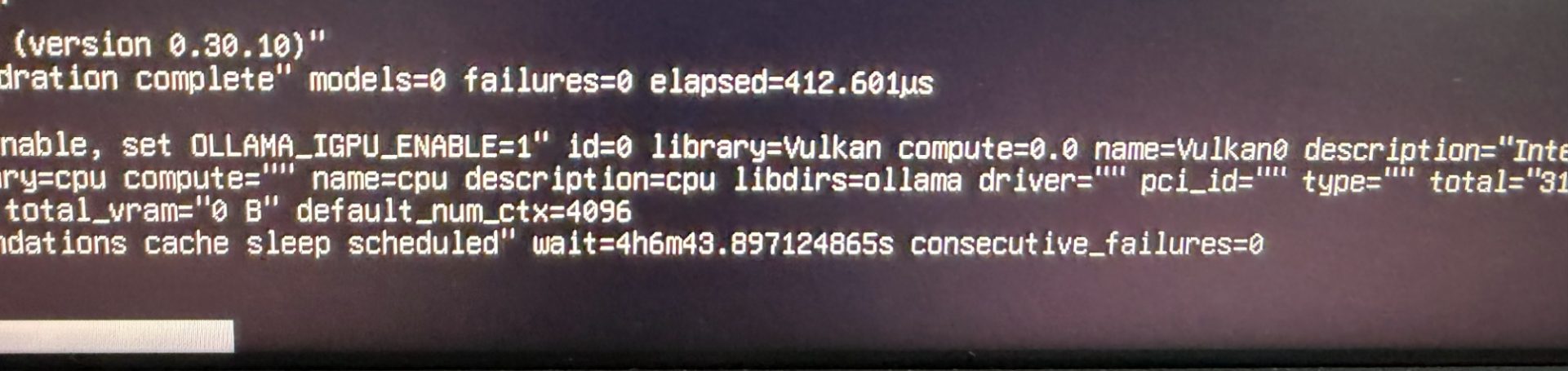
Ollama had recognized the storage pool I assigned, and mapped out the storage location in 0.41 milliseconds.
I installed Ollama to the OS drive, while mapping the “brain” of the LLM to the storage pool. Engineering this particular array, with the LLM module installed there, allows the processing of data at near-zero latency. I was able to observe the data moving across the fabric to the board and on to the cpu and ram in microseconds. The LLM was able to “think” faster than the system could output the results.
After running both tests, before and after, it was clear that my APM wrapper was able to reduce operating overhead between the process handling of the cpu/ram/bus and the fabric “brain”. Due to this reduction in overhead, the entire system was able to compile and report on the data much more efficiently, by completing the same test 35 seconds faster than without the wrapper running. This reduction also allows for a token to be stretched further for use and also burns fewer tokens to accomplish the exact same task.
Due to this deterministic behavior out of the LLM, I was able to cancel any query with a simple ctrl + c command. It immediately stopped the given task, and without hesitation or any observable lag, the LLM made itself available for the next query. I ran this test 30 times in a row, cancelling a query either while the LLM was compiling data, or reporting on the data. Every time I cancelled the query, the LLM was immediately available to run the next command.
Despite these tests being run on a Proof-of-Concept device, the use cases do not change. This machine is still a headless Linux server, running the latest Debian package, albeit much, much faster than one would expect from what appears to be a common enterprise desktop.
My APM wrapper takes an otherwise chaotic mess of data being streamed from the source, and feeds it into the system for processing in an orderly, controlled manner, ensuring the orchestration layer doesn’t become saturated with leftover data from previous queries. Every execution is controlled to ensure stability and predictability.
I believe that my APM wrapper is the solution to assist in mitigating heuristic issues and false data from infiltrating known good data, helping to build a better foundation to lay governance, trust and accountability upon. The governance and trust frameworks that we currently use are adequate and may only need to be adjusted slightly to accommodate the stability that would result from an Agentic system utilizing my wrapper.
I am curious if any of you out there that have been following this project have any comments or questions about my build or my wrapped LLM deployment. Let me know in the comments below, and I’ll gladly answer your questions the best that I can.
(c) 2026 Mark D. Allen - Vector Logic & Forensic UG (haftungsbeschränkt). All rights reserved.
VL&F Presents: The State of the Union Address 2026
In today’s cyber landscape, we are dealing with an entirely new paradigm. The variable that changed everything? AI.
June 27, 2026
When I started my journey in cybersecurity back in 2019, my goal was to transition the physical security knowledge I’d built up over years into the digital realm. Back then, AI was still an infant in commercial terms. Yes, artificial intelligence has been with us for decades, but its practical capabilities weren't even close to what we are witnessing today.
Now, we have a potent tool that the industry is still struggling to fully contextualize. It can hunt for bugs and vulnerabilities, mitigate threat vectors, and - when the alerts aren't chiming off - generate cat pictures for us.
The Scalpel vs. The Hacksaw The one thing we cannot seem to agree on is implementation. Everyone has an opinion on what to use, how to use it, and exactly when not to deploy Agentic AI. I fall into this category myself.
What we collectively need to realize is that the way we use AI right now is more akin to a hacksaw - hacking and chopping away at systems and processes. I believe we should be using it like a scalpel: conducting strikes and threat hunting with surgical precision, not brute force.
The Governance Vacuum This brings us to the real elephant in the room for security professionals: trust, compliance, and governance.
Everyone is rushing to push agentic features out the door, but is the underlying data fully compliant?
Consider this scenario: What happens down the road if an AI Agent signs off on a compliance audit as valid, only for it to be exposed as completely false months or years later?
- Who is held responsible?
- Can we lay the blame solely on code executed by a server, despite how "smart" it appears to be?
- Who ultimately pays the price if a company has to backtrack on data previously held as source-of-truth? The CISO? The CTO? The CEO?
What happens if that company is a global leader, and the resulting fallout forces them into bankruptcy?
Saturated Markets vs. Base Ingredients These are the questions I ask myself every day. It’s why I’ve focused my work so heavily on why our systems are failing us, and how we can structurally mitigate these systemic problems.
It is no dark secret that our current frameworks are flawed - the entire industry knows it. We see it daily on our feeds, packed with a multitude of vendor options and flavors to choose from. Innovation keeps our market afloat, but if we spend all our time making different flavors of hot sauce based on the exact same recipe, rather than fixing the base ingredients, we are just heading toward market over-saturation.
This is my take on the current state of our industry, but I want to hear yours.
Where do you stand on Agentic AI liability, and how is your team drawing the line between the hacksaw and the scalpel?
(c) 2026 Mark D. Allen - Vector Logic & Forensic UG (haftungsbeschränkt). All rights reserved.
I'm Looking For a Technology Partner
This could be a stratigic win/win for us both
June 25, 2026
Hey LinkedIn community!
They say timing is everything, and in almost all instances, that old adage is correct.
I alluded before, that most legacy infrastructure operates under a dangerous architectural assumption, that a single software-clocked instruction is enough to guarantee a deterministic physical action.
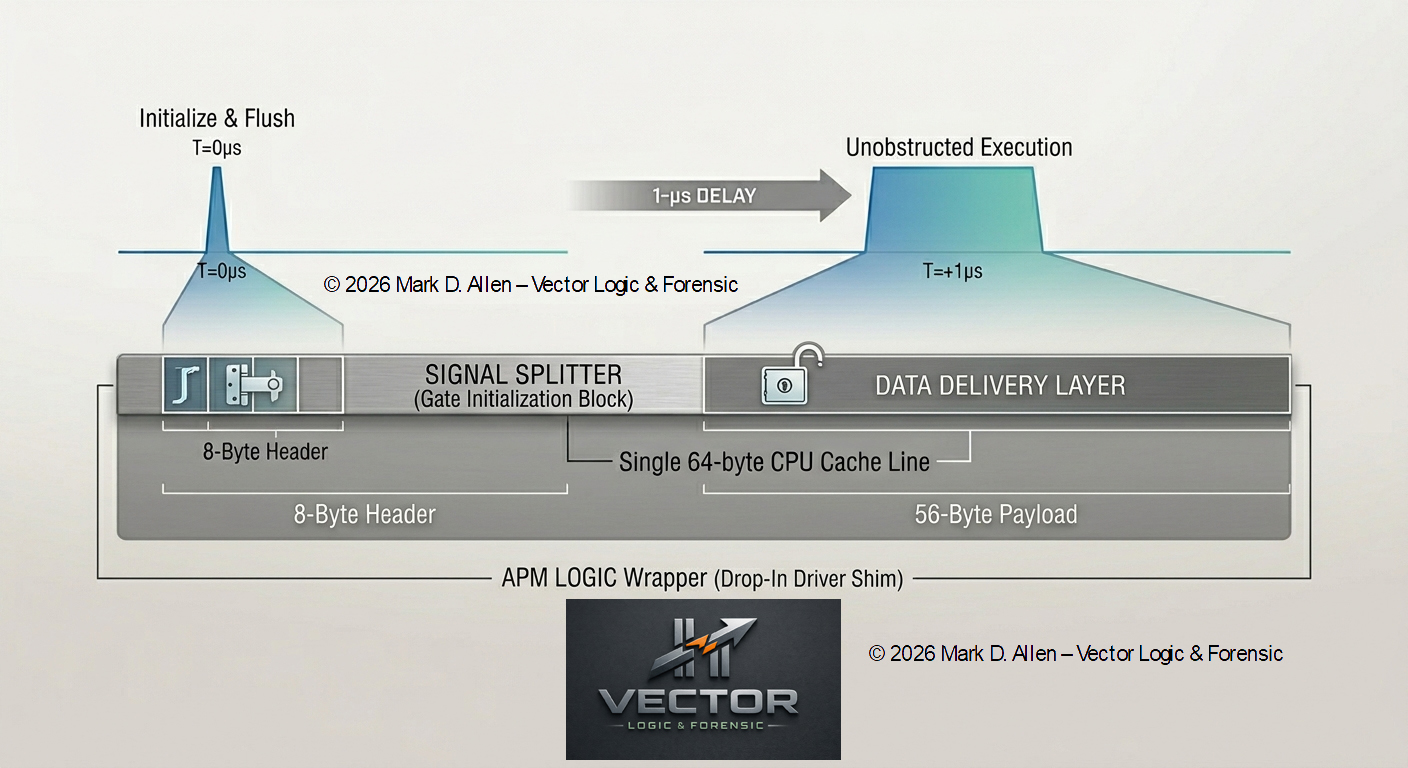
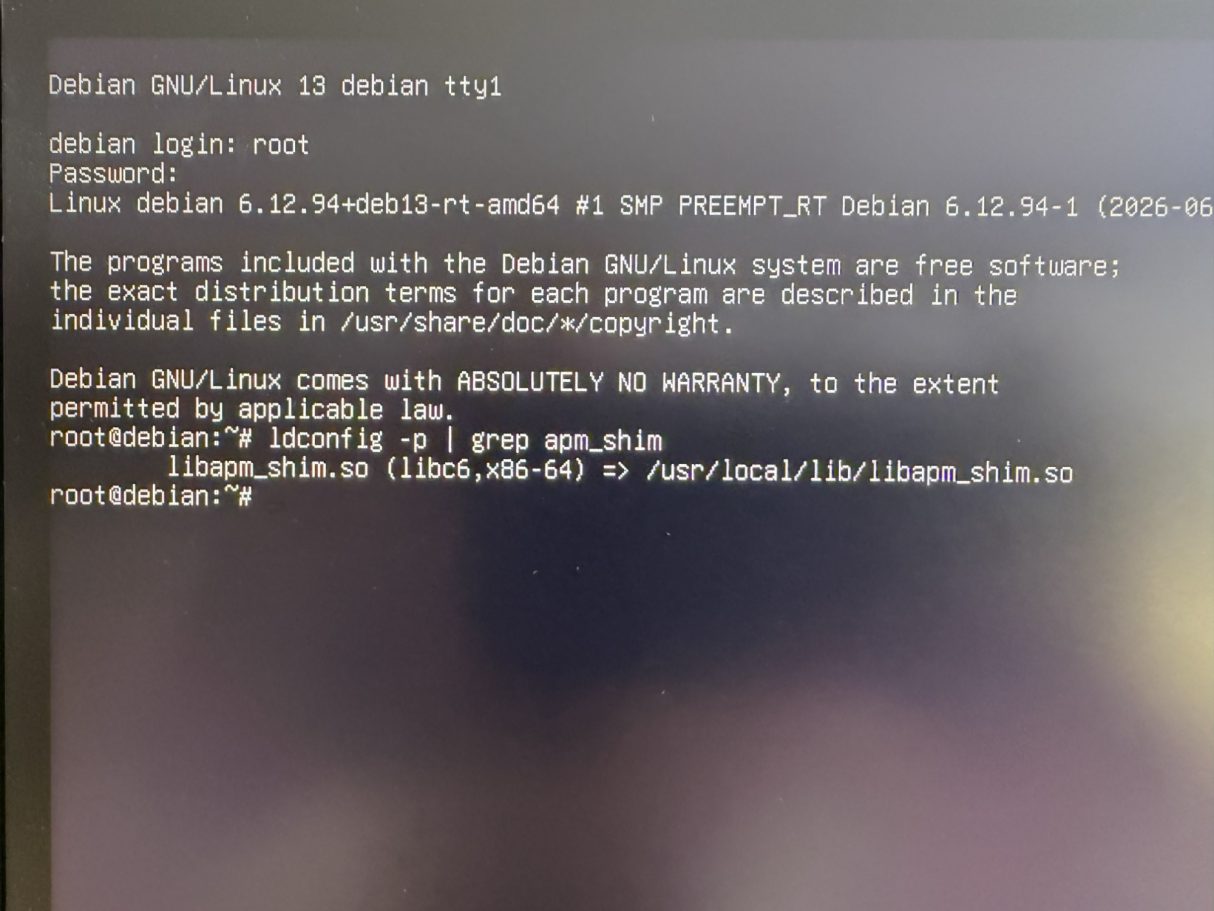
It isn’t, and in the images I'm sharing, I have developed a software defined "Gate" to act as a signal splitter, sitting in between the execution layer and the orchestration layer.
This driver shim splits the outgoing data stream into manageable bites, clears the orchestration layer of any residual elements from the previous instance, then delivers the rest of the execution layer payload for processing.
Deployment can be on either Windows or Linux based servers, takes up less than 100kb of total space, and installs / uninstalls like a typical driver.
The Vector APM (Asymmetric Pulse Modulation) Wrapper is a lightweight, proprietary software/microcode engine that forces absolute determinism at the hardware-software threshold. By intercepting incoming data streams and constraining them to an axiomatic, cache-line-optimized execution sequence, the wrapper establishes a bulletproof temporal buffer. It physically flushes residual state latency and guarantees predictable execution before the legacy system can commit an action.
As you can see in these pictures, the shim is nestled nicely in Debian and waiting to do its thing. That is where you and your environment come in.
To clarify scope- I am not looking for a live production environment. The objective is a controlled sandbox or simulation environment where we can rigorously test my driver shim within its intended deployment landscape.
There is no rush- I am targeting a window of 4 to 6 weeks from now to allow for proper preparation and alignment.
If you, your organization, or someone in your network has the infrastructure and interest in collaborating on this validation phase, please send me a DM so we can discuss the technical details.
Thanks for your support and connections!
(c) 2026 Mark D. Allen - Vector Logic & Forensic UG (haftungsbeschränkt). All rights reserved.
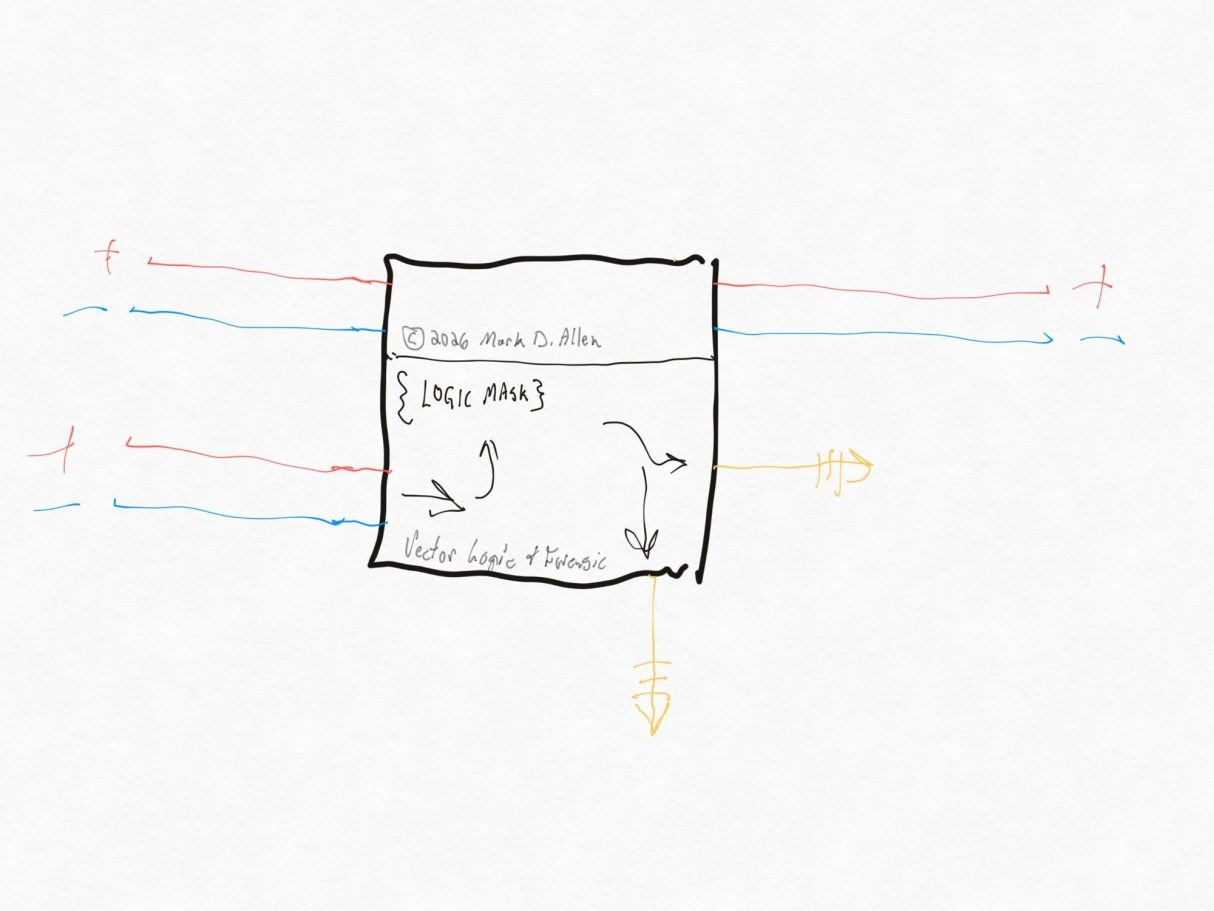
An ASIC Boardbound Signal Diffuser
June 23, 2026
While conducting research on bus topologies and mechanisms, I engineered a new ASIC design that allows communication to pass through one bifurcated channel while changing communication on the parallel channel into electrical energy that is safely absorbed by the board.
This enables true hardware-enforced, one-way communication over a bus line while maintaining a stable, impenetrable wall on the reverse path.
(c) 2026 Mark D. Allen - Vector Logic & Forensic UG (haftungsbeschränkt). All rights reserved.
A New Type of Linux Server
A new Deterministic Linux server build
June 23, 2026
I was busy on the weekend, and my assumptions about Linux running more potant were correct.
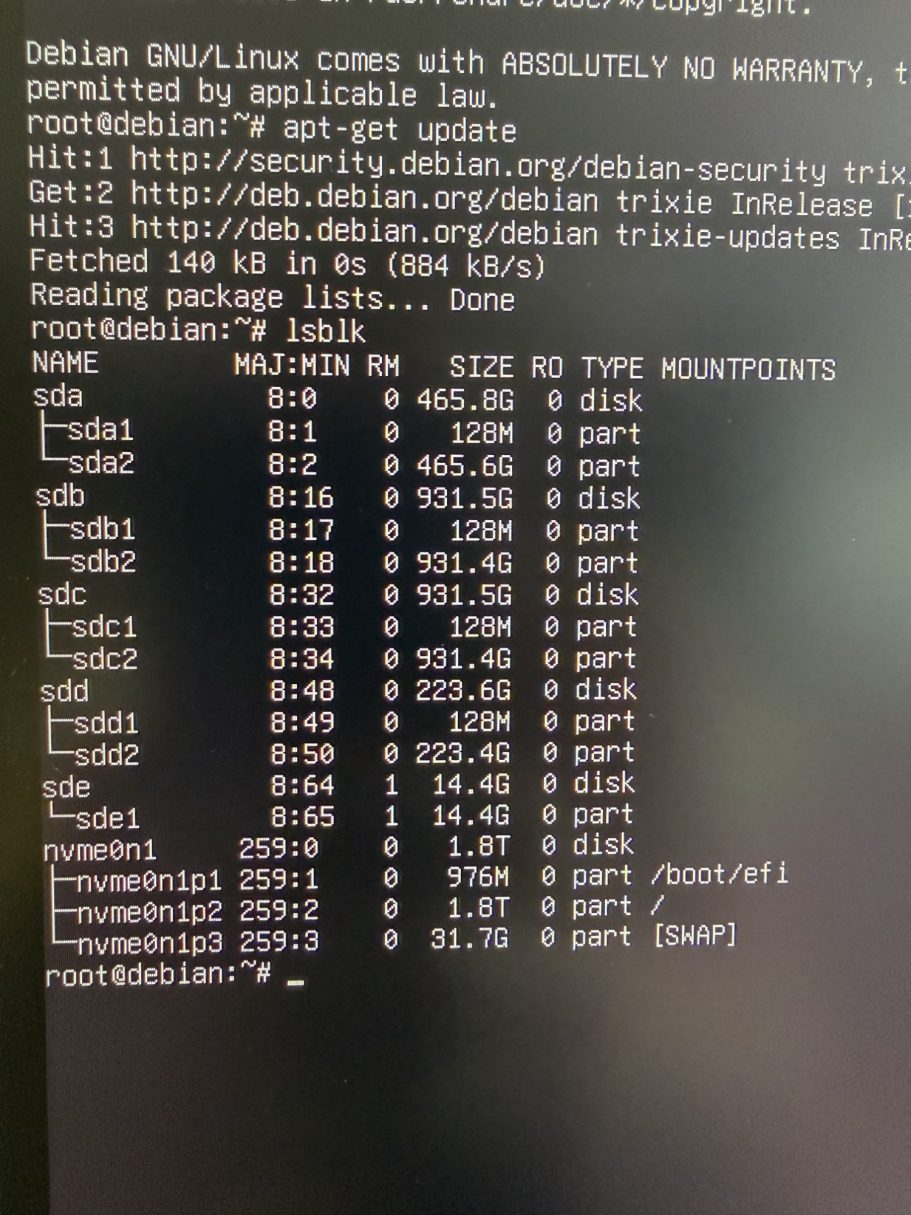
This is still a proof of concept device, so testing is ongoing, nor is everything set up. Debian sees the Storage Pool and can r/w to the pool, but there are a bunch of other things I still need to set up.
Taken as a proof of concept, so far this system is displaying the same predictable, deterministic behavour as the Windows environment.
-> Everything still runs off the bus / PCIe
-> The Storage Pool still operates at near-zero latency
-> Power / reboot cycles are mere seconds
It doesn’t matter the operating environment, as long as the OS is installed in a bare metal manner, the system will automatically configure itself to operate as high-end desktop / server hybrid.
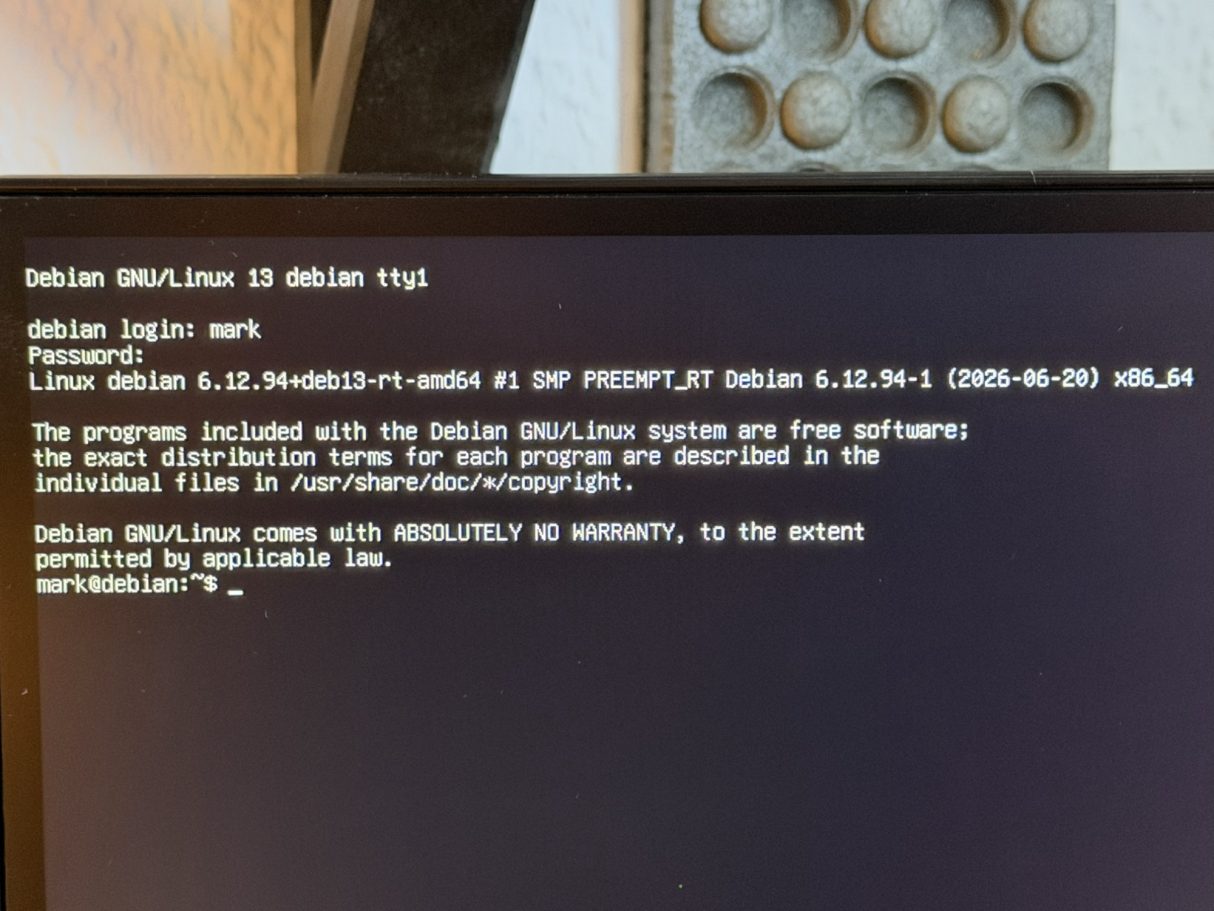
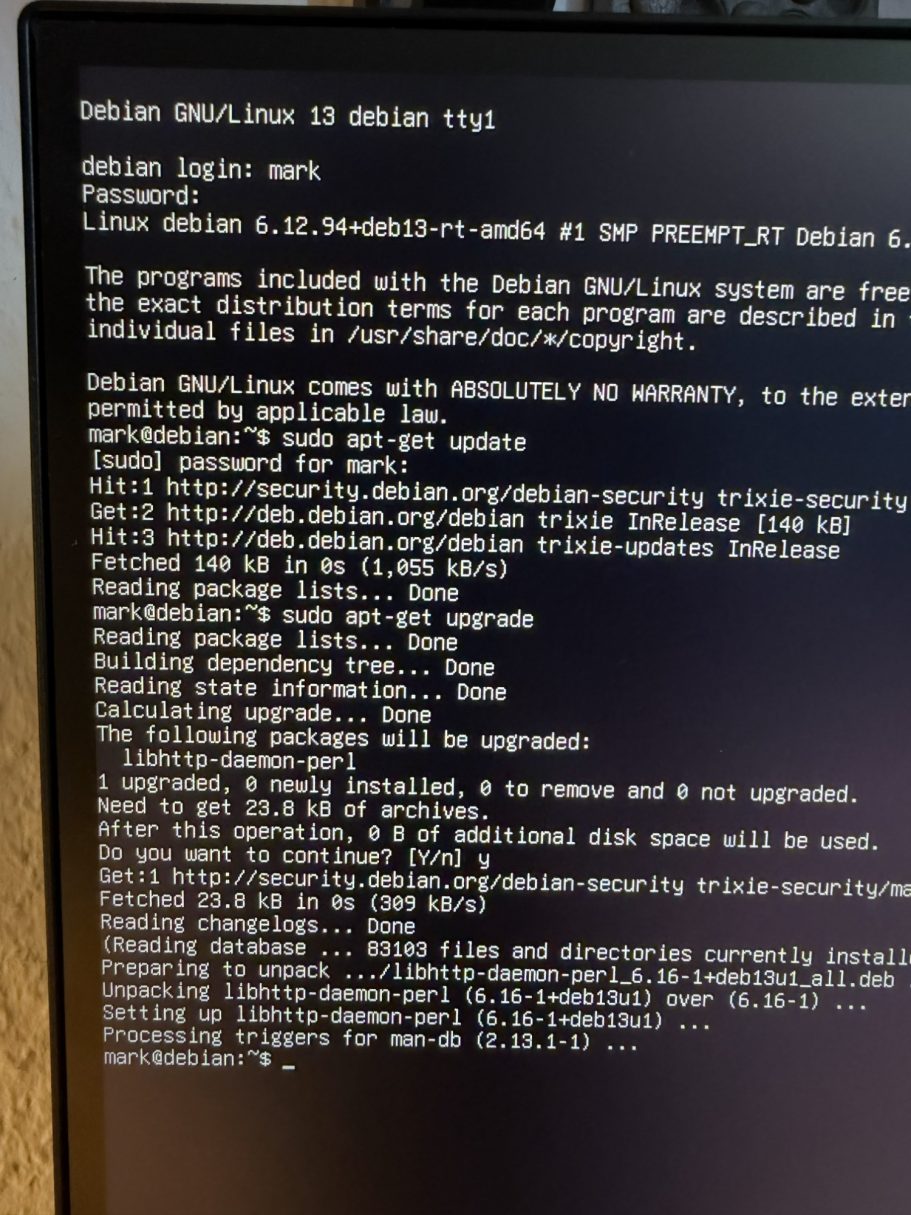
This machine is now running the latest Debian 13 build, completely headless, and is not only easy to maintain, deployment is near instant. Some commands run faster than your eye can blink…
(c) 2026 Mark D. Allen - Vector Logic & Forensic UG (haftungsbeschränkt). All rights reserved.
The Paradigm of Modern Computing
A proof of concept in Deterministic Computing
June 18, 2026
Over the last few days, I set out to build a different kind of PC. One that didn't rely on the typical constraints of modern computing: software stacks, drivers, transition layers, etc.
The main problem I was having with the way my workstation was behaving, was with resource allocation. I make music in my spare time, so latency is a huge problem for me, hence me choosing a workhorse CPU versus some flashy RGB encrusted one. A 6/12 spread with 32gb of decent RAM is the perfect sweet spot for me. I'm not new at this.
I use Reaper as my DAW to record and track my songs. I also use SoundForge to do my mastering. Both are Studio-Grade software, and require their own stable resource lines. When there are abstraction layers upon sub-routines, stolen clock cycles and microjoule dips in power delivery, it's no wonder I struggle with latency. I'm currently working on a track that has 27 stems with multiple vsts on top. The system was choking on recursive loops and stolen clock cycles looking for which direction the path was to a particular vst or stem. Not any more.
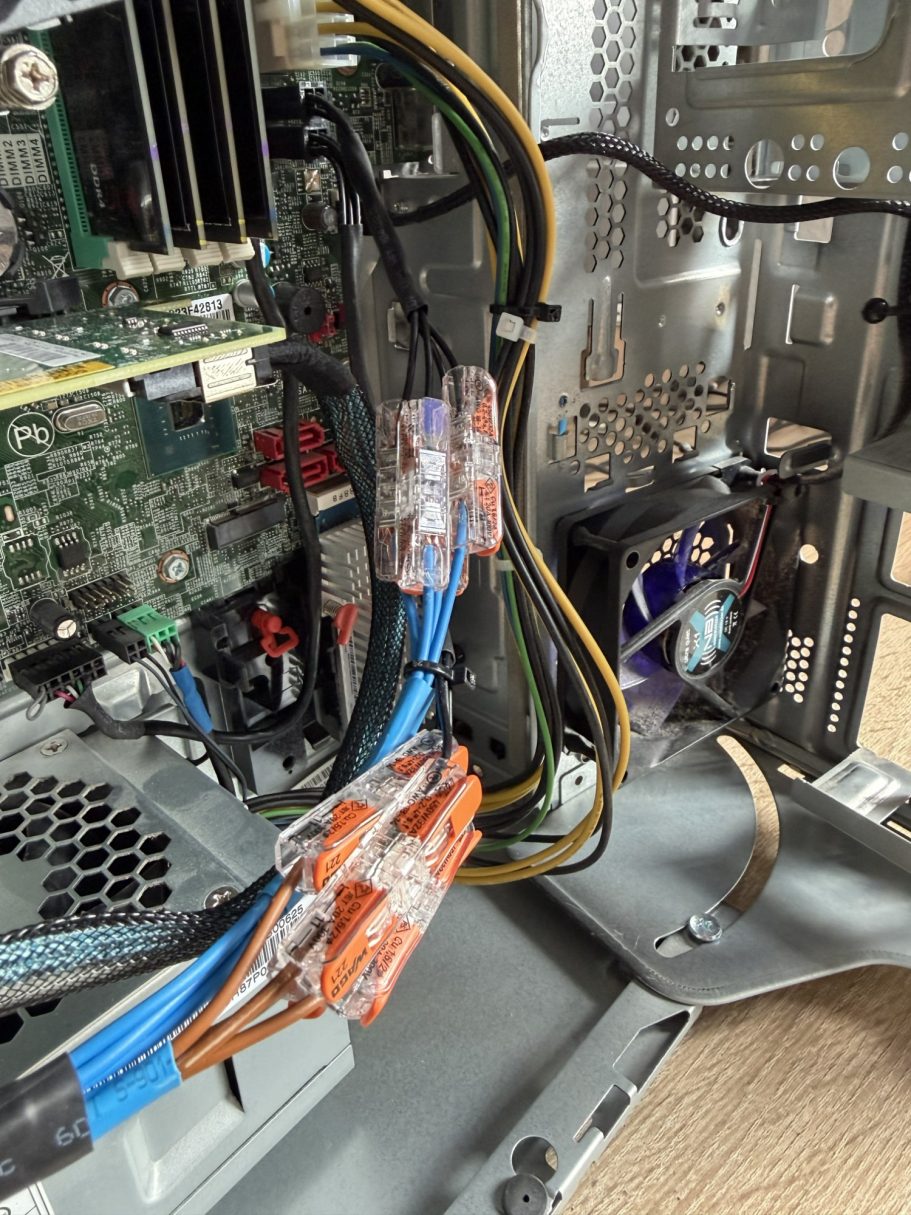
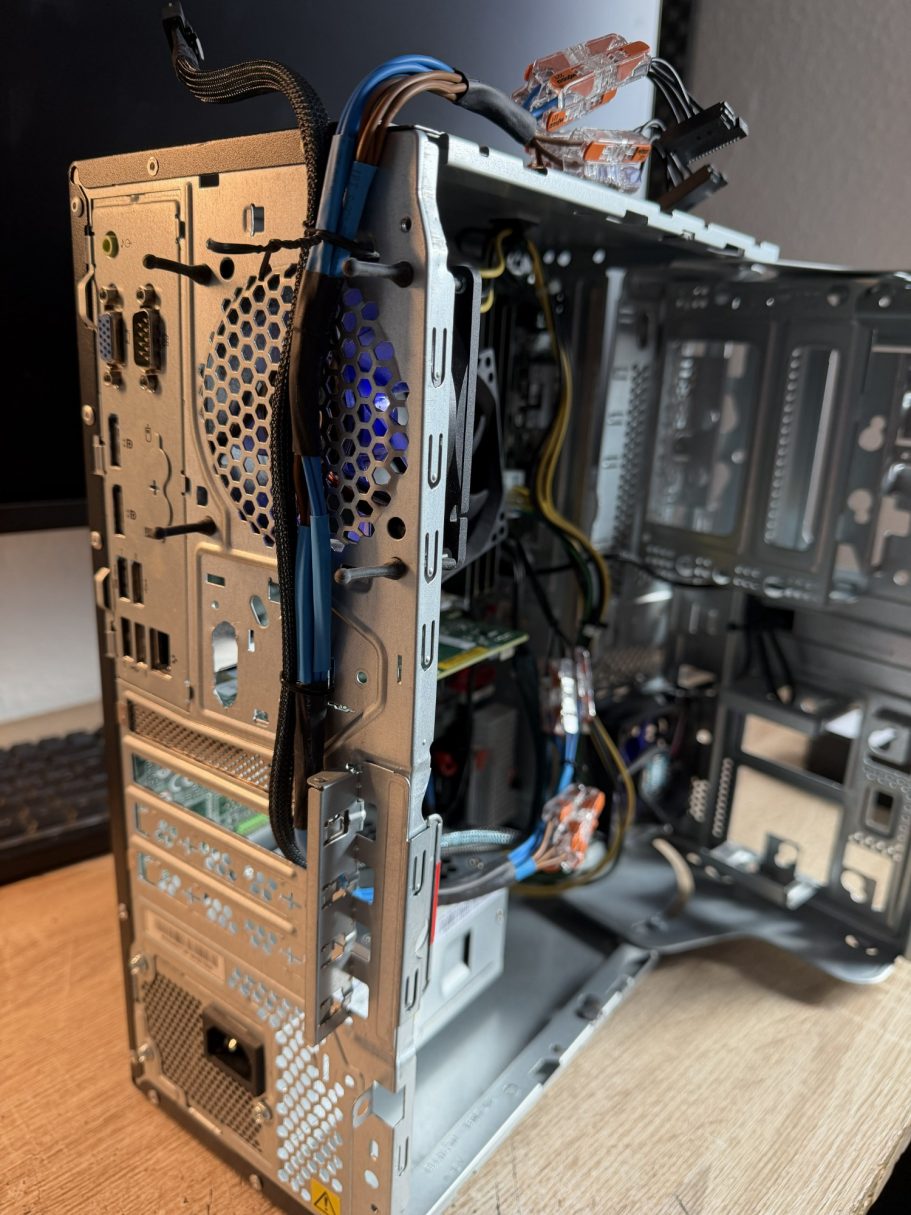
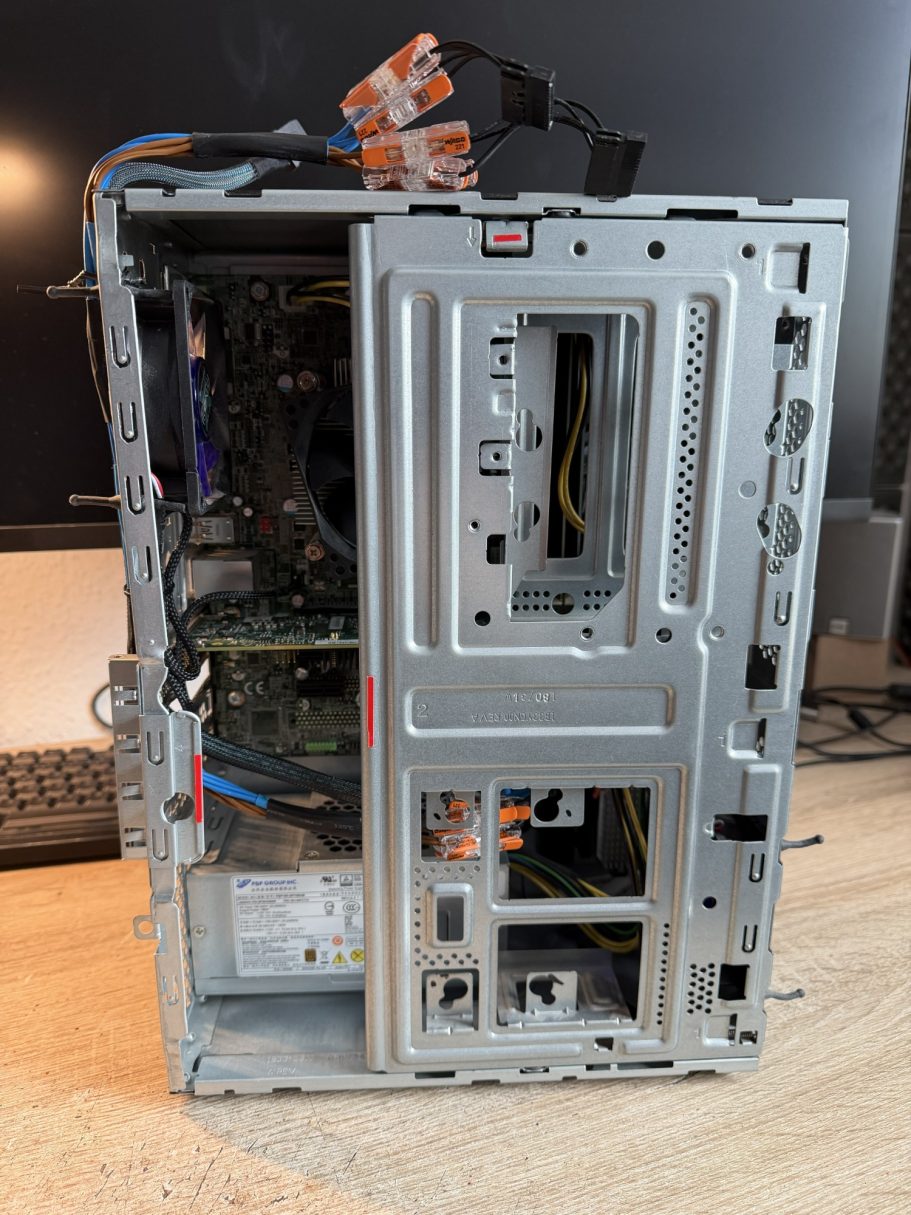
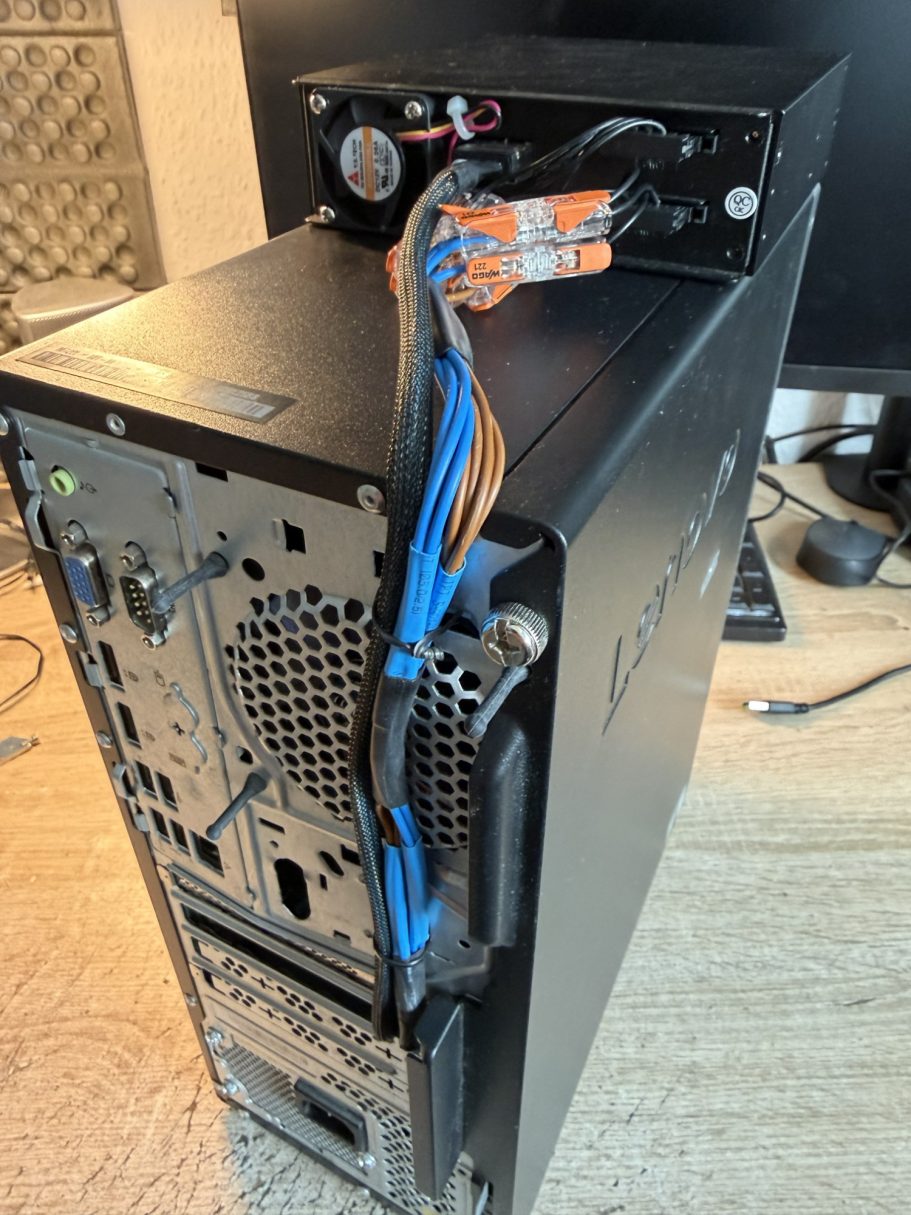
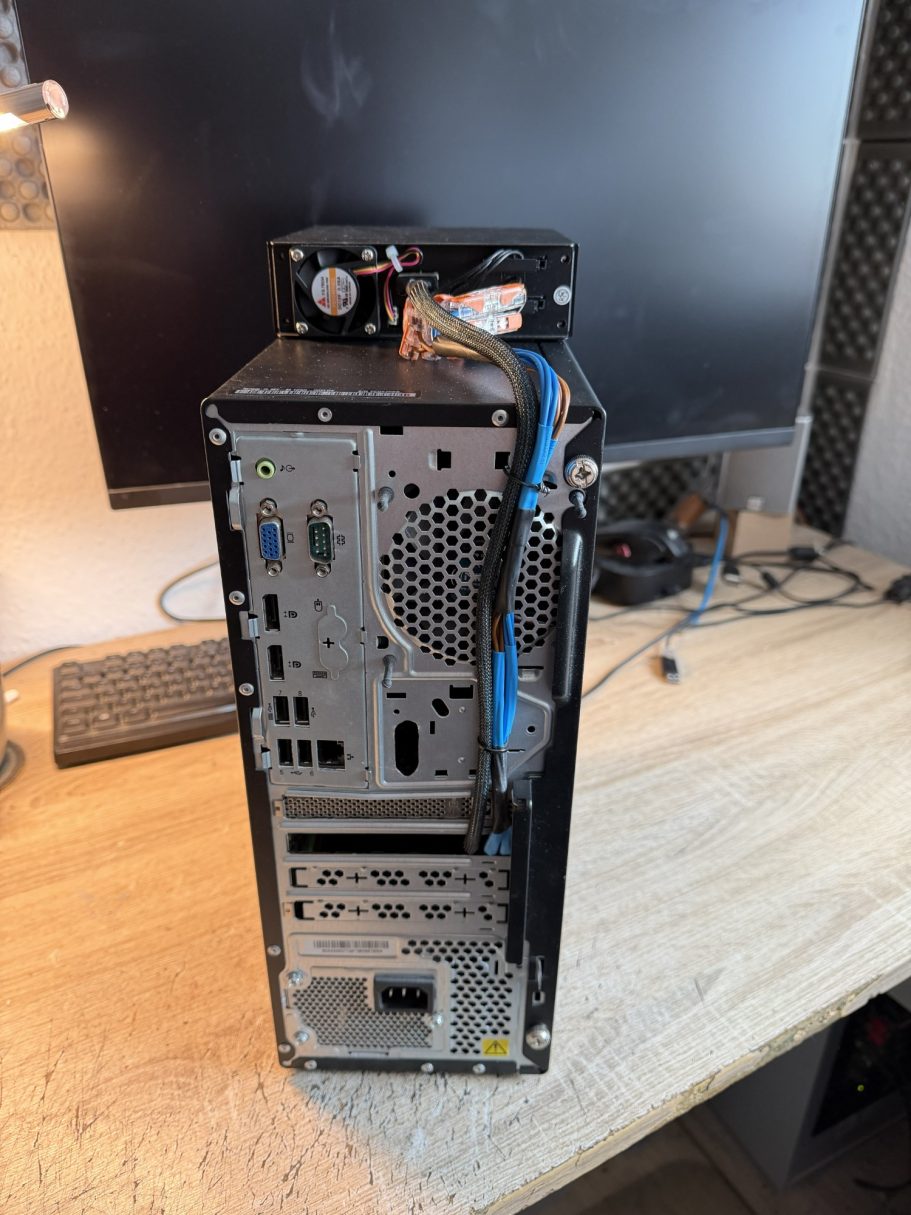
What I managed to achieve in my build is a system that runs totally on silicon, utilizing the motherboard's own bus architecture to it's absolute fullest capacity. This is still technically a windows PC, as there is a dedicated c:/ drive holding the OS. I just happened to install Windows here. Linux would have worked as well, and would probably be even more potent. How this machine is built, and what is happening under the hood is the difference. Everything is off the shelf, and used. The LSI HBA was purchased from eBay pre-flashed in IT Mode, directly out of a server.
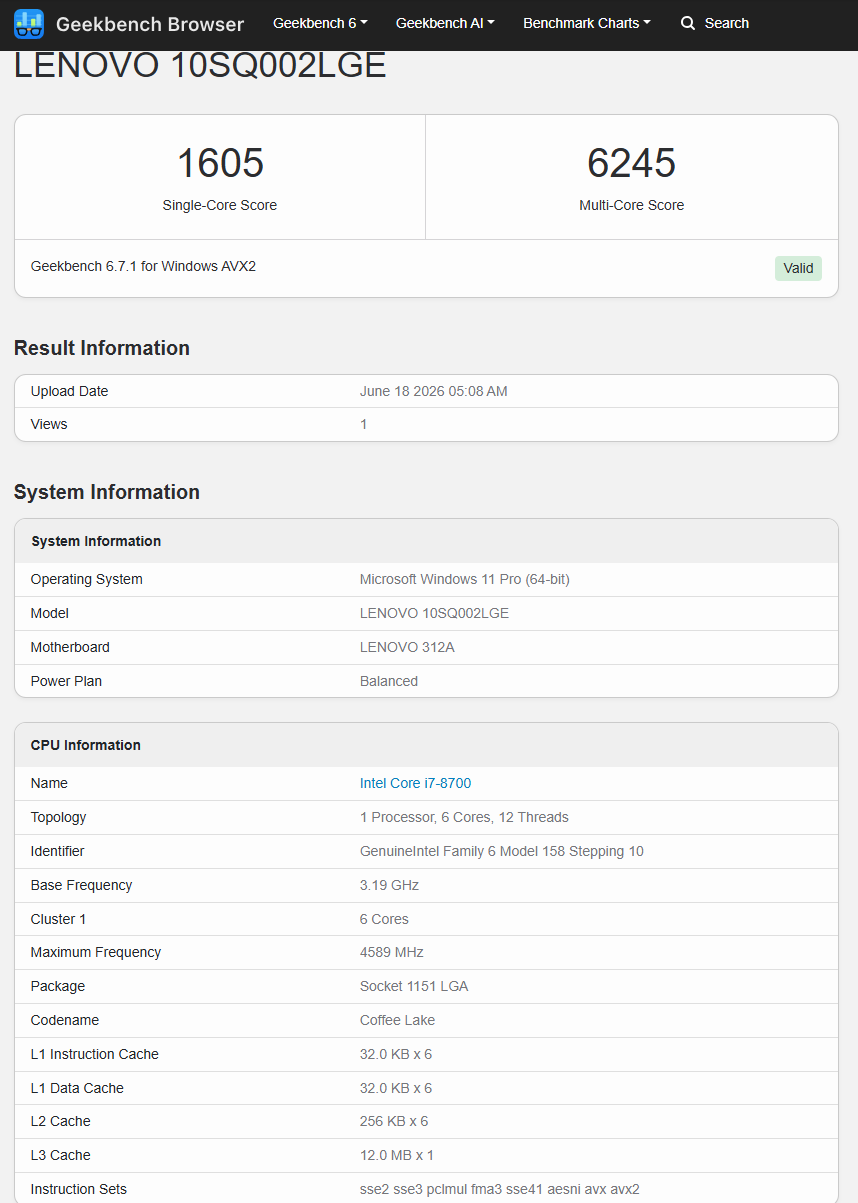
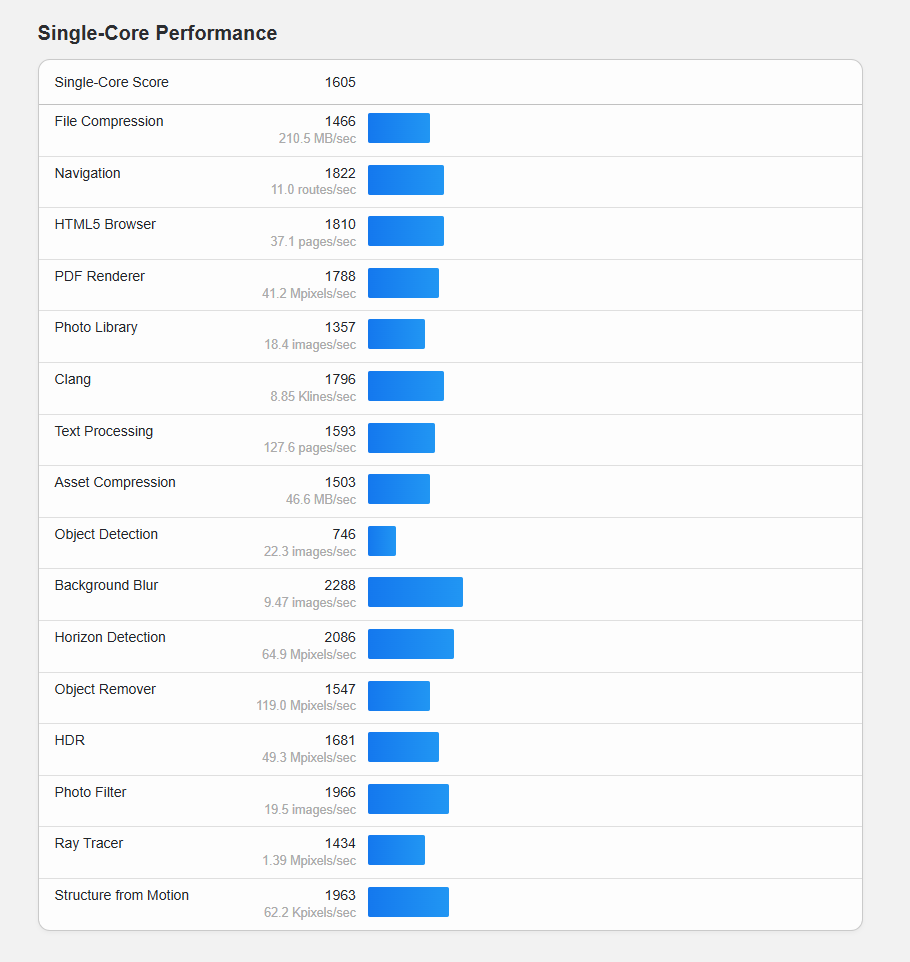
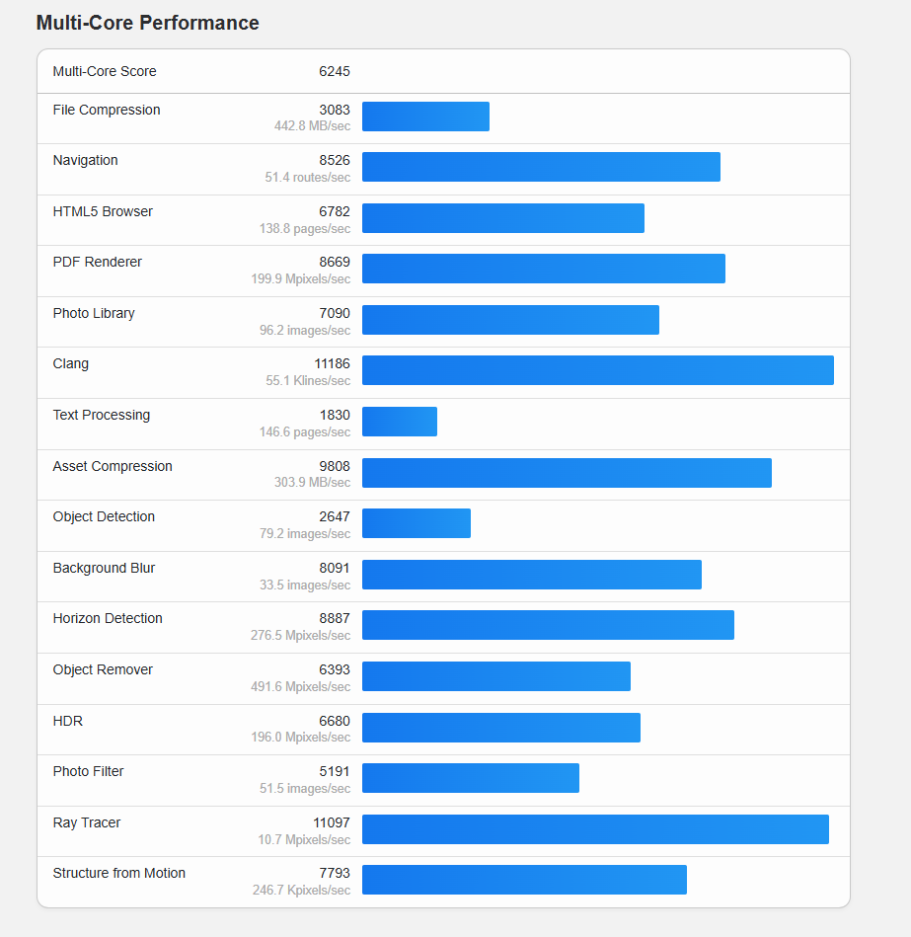
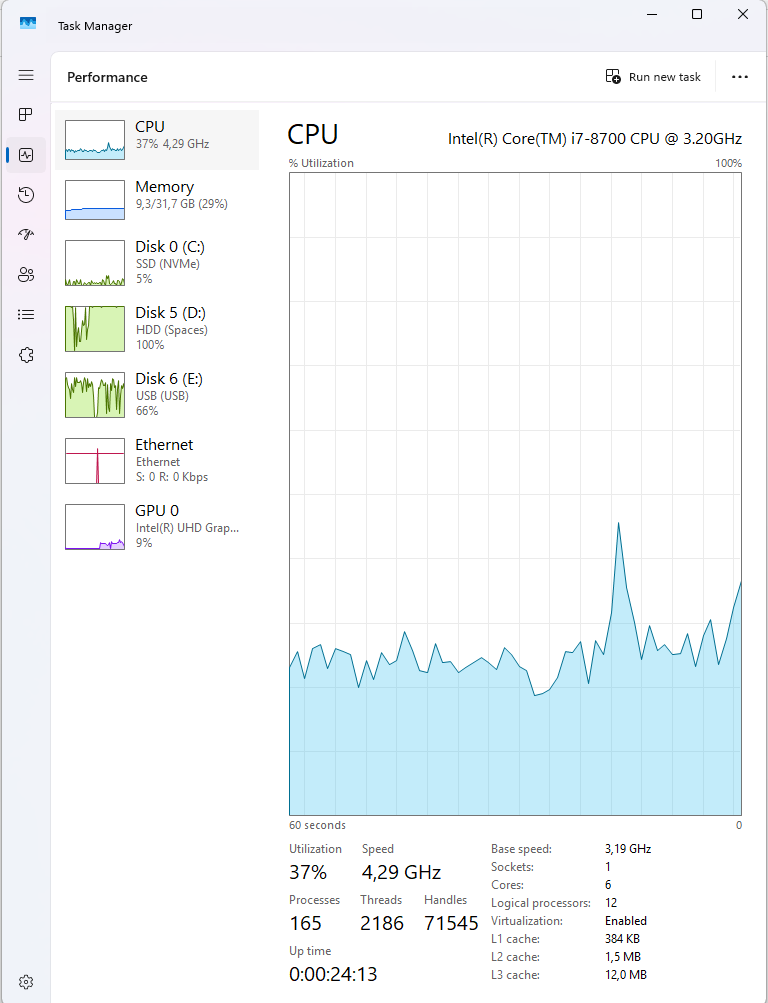
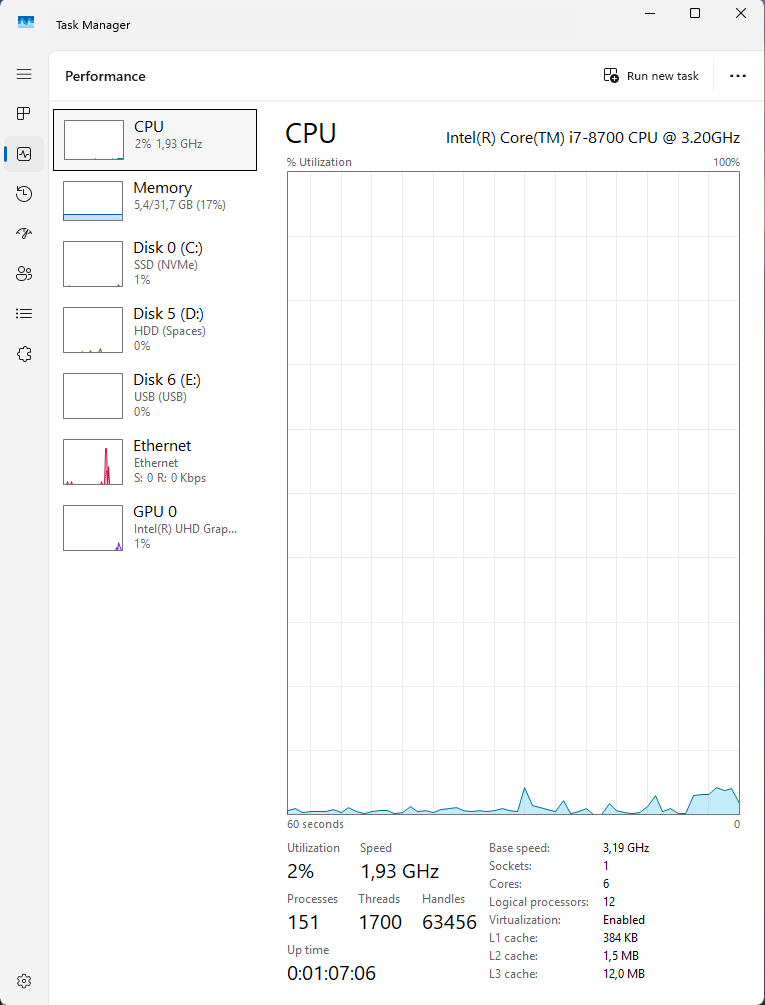
After hours of testing and running Geekbench 6, I can report on this:
From a cold boot, once the system has cleared post, you aren't greeted by the usual W11 loading screen with the spinning white circle underneath, you are greeted with your login screen right away. I was able to immediately enter my password, not having to wait the customary few seconds until the keyboard driver loaded over USB. Again, zero lag wasted on transition screens. As soon as I clicked enter, my desktop was already waiting for me, and it took no longer than 3 seconds for Windows to populate the entire motherboard bus.
Now, when I tell Windows to search for something or execute a command, Windows doesn't hesitate because it knows where everything is. When calling up saved music from the Data Pool via Windows Media Player (yes, I know... nostalgia), there is zero lag in not only opening WMP, but as soon as I double click on which ever song, it starts the microsecond after the second click is registered.
Back to my latency issues with Reaper, they don't exist any more. Reaper instantly loads, including all stems and associated vsts. Checking the Performance metrics in Windows, running that exact same scenario with my 27 stem track, the system only used 5% more CPU clock cycles, and 1.5gb more RAM than baseline. Everything else was handled on the bus.
Architechtural Topology & Hardware Manifest
Here is exactly the setup I used. It can easily be replicated, upgraded and modified as need be, due to the inherent modularity:
Standard Lenovo 312A motherboard with an Intel i7 8700 CPU and stock fan assembly. My OS drive is a Samsung 890 Pro Gen 4 NVME. RAM is 4x8gb GSkill Aegeus PC4 24000. LSI HBA is a typical HP220 PCIe x8 card. Simple Raidon 4-Bay SAS enclosure with a 500gb Samsung 870 Evo and 240gb Toshiba HD200 SSDs layered in front of two 1tb each Samsung Momentum and WD Blue HDDs.
When testing this new system, while the side panel from the case was off, I recorded a +1.2°C increase in air temperature inside the case. After I finished the assembly and reseated all the panels back in place, the ambient temperature dropped to +0.7°C. This is above normal room temperature of 18°C. Negligible difference.
The Deterministic Interconnect Topography
There are only 6 Fabric Points in this deterministic approach, where any device touches the motherboard:
1) The CPU and it's socket.
2) The RAM and their connector rails.
3) The NVME and it's connection header.
4) The LSI HBA and it's PCIe lane.
5) The USB header for the chassis mounted reader.
6) The backplane of the SAS enclosure, via the HBA and cable.
The only other connections to the motherboard are the PSU lines and the case fans.
Scalability & Operations
This is a proof of concept device that can be easily reproduced with the right hardware, and more importantly: scalable. With this topology, the only limitations are the data through-points via physical connectors, be it USB speed caps, or the amount of buffer your storage devices have. If the motherboard bus is allowed to run as openly and freely as possible, as long as the interconnects have zero or near-zero latency, scalable deterministic computing isn't just theoretical, it's now a proven reality.
The ultimate question comes down to this: how well can you see this architecture fitting in your operations?
(c) 2026 Mark D. Allen - Vector Logic & Forensic UG (haftungsbeschränkt). All rights reserved.



My View on "Wholisitic Security"
I wanted to cover what “security” means to me.
June 13, 2026
Not in the separate terms of online vs physical security, but the whole package, and how it all relates together for a wholistic approach to modern living.
It is obvious to see that my background revolves around asset protection and risk mitigation, no matter the playing field. These are the choices I made throughout my career to get me to the point where I am now. My choices aren’t meant to reflect a blueprint for some magical protection layer that save one from total calamity. What it shows, is that I have a good understanding of how plays are made at the ground level.
Acronyms like SitAware (Situational Awareness), OpsRed (Operations Readiness), OpsSec (Operations Security), or even forms of SCI (Sensitive Compartmented Information) are terms I use on a daily basis. This kind of thinking and mindset makes you incredibly sharp, ready for anything to go sideways at a moments notice, and ready to jump in for damage control.
I’ve been also to impart some of that knowledge on my wife and son without making them paranoid. They can go out, have fun, do what needs to be done, and make it back home intact. If any issues arise that is beyond their scope, they know to back off immediately and disengage from the situation. The same can be said for their self-defence. They have both been instructed in adequate self defence and SitAware, so I know my kid isn’t going to come home with a bloody nose. That’s all they need. More awareness than the average person, and a little more critical thinking before jumping headlong into something.
I don’t need to worry about my own personal security, as it never gets that far. I’ve had enough courses in conflict de-escalation to not need to rely on physical force. I haven’t had to “lay hands” on anyone in years, but a pen is always in my pocket, just in case.
My digital security is a whole other beast. All my devices are encrypted, with a minimum of 12-character passwords not passcodes. VPN technologies are used on every device in my household, configured to match current NIS2 guidelines. 2FA (two-factor-authentication) is enabled on every single app/ program that will allow it. All messaging services are hard locked with FaceID. Location services are set to the absolute bare minimum to function. I love and use cloud services as part of my operations; I just have all my settings set to reflect my higher security standards and think twice before uploading any random file into the cloud, secure or not.
The last, but most important thing to add about my operations mindset: no “smart” devices. Aside from some phones, tablets and computers, you will not find one other piece of “smart tech” in my home. Not only are they an unnecessary risk factor from a network security standpoint, but there is also the implication of unwanted conversation data being recorded. That is a debate for another time, but to mitigate any risk now, we simply don’t have any. You can’t miss what you don’t have.
This brings me to my operational mindset, and why it sets my level of security apart. A lot of people try to bridge the physical and digital realms of security, but it is not an easy bridge to cross. The real-world doesn’t like to play nice with even the best paid plans: one unaccounted variable, and the whole landscape changes in the blink of an eye. This is how life and business works, plain and simple. How people and companies respond and adapt quickly enough is what makes the difference between a successful operation or remediation, or complete atrophy and loss.
No one can predict the future, but if you keep your eyes open enough, and read the tea leave scattered in the wind, it’s easy to see where things are going.
Claiming to be agile is fine, but when push comes to shove, can you really step up in that moment and prove you’re agile? That is the question we all need to ask ourselves.
(c) 2026 Mark D. Allen - Vector Logic & Forensic UG (haftungsbeschränkt). All rights reserved.
The point where math, security, and governance collide.
The current X-OR Collapse
June 12, 2026
Elegant, isn’t it?
The exact point where mathematical complexity, hardware-level security, and deterministic governance smash into each other.
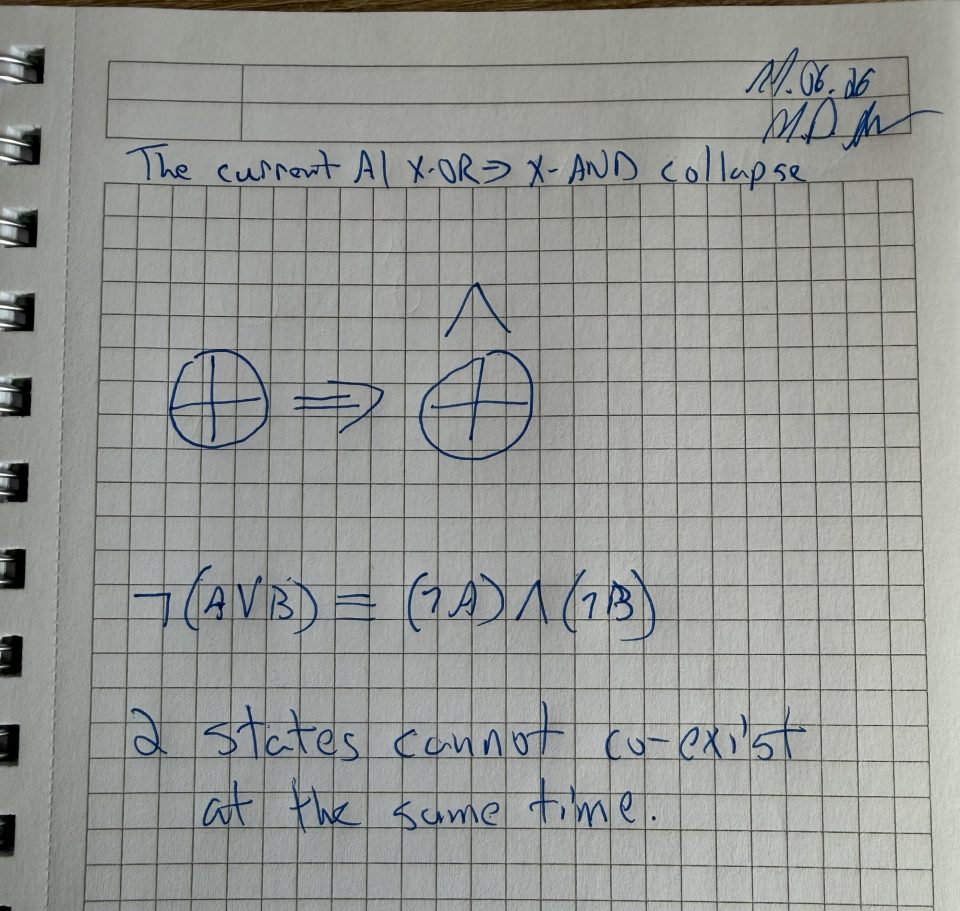
While deep diving into a postgraduate-level computer science framework out of Brussels, I paused the lecture to sketch out this structural transition in my notebook:
The {XOR} -> {AND} Collapse ( ⊕ → ̂⊕ ).
In pure hardware and cryptography, {XOR} ( ⊕ ) is the ultimate tool for entropy and obfuscation - hiding state information perfectly. But for deterministic governance, compliance auditing, or cross-border infrastructure forensics, that hidden variance can become an architectural blindspot.
By collapsing that relation into a strict {AND} constraint ( ̂⊕ ), the physics of the execution path changes completely:
1- Entropy is Capped: We move from a permissive, shifting relation to an ironclad gatekeeper condition.
2- Absolute Determinism: It enforces a fundamental axiom - a True and False state cannot coexist simultaneously. There is no room for concurrent paradoxes or gray areas; the criteria must be entirely satisfied for the gate to drop.
Using this shorthand notation to map state boundaries provides a pure, axiomatic foundation for enforcing zero-trust policies directly at the logic-gate layer.
Never underestimate the power of a pen and paper to distill massive system architecture down to its raw primitives.
(c) 2026 Mark D. Allen - Vector Logic & Forensic UG (haftungsbeschränkt). All rights reserved.
A Deep-Dive Into the History of Deterministic Trust
I wanted to share a little about my background and how I got to where I am today.
June 10, 2026
Anyone can easily look at my Experience Field and my Certifications to see that I come from a security and leadership perspective. That is only the “piece of paper” side, the same as any CISO certificate.
My perspective comes from years of battle-tested methods of what works, and what goes catastrophically wrong. What your staff look to, when they see their leader, giving them the trust and authority to embolden and empower them, to aid in their own critical decision making.
Getting into physical security at a younger age, helped to instil a rigorous discipline that the governmental agencies had, but without the commitment or lack of a completed university degree. I realized early on that I had a natural ability to connect with people, and help to motivate them, while motivating myself.
I have carried this same core principle through in everything that I do thus far. From my work life to my private life, I try to embody trust, respect, and honesty at every level, with every person. My wife; my kid; my friends; my coworkers, it doesn’t matter. When someone meets me for the first time, they know exactly what I stand for, in the blink of an eye. That is the entire point of “Security by Design.” If there is no reason to suspect any misgivings, there will be no friction down the road. It’s really that simple.
Being this involved in security operations has resulted in an unprecedented view of real-world viscosity, and the effects of every single impact that can occur down the pipe. From human collateral mitigation during Game Day events or enacting critical and emergency protocols for a luxury condo building during a riot in the downtown core of Vancouver, after a dramatic hockey game loss.
From being asked to assist the plain-clothes security team, despite my name badge clearly stating, “department manager,” clearly showed a level of respect and camaraderie that rarely exists in cross-format operations. This level of trust isn’t readily given, it’s earned: through exercising the exact message you want to convey.
To mitigating and navigating a personal family crisis involving the passing of three members of the same family within a short span of time.
These are the trials that test our resolve, and our ability to stay human, under the most inhuman conditions. We as people were meant to do more than to give our individual sovereignty away, we were meant to connect with one another and forage those bonds of trust amongst ourselves.
If we can collectively realize that WE are the answer, this world will be much easier for future generations to navigate.
(c) 2026 Mark D. Allen - Vector Logic & Forensic UG (haftungsbeschränkt). All rights reserved.
Reclaiming Your Digital Sovereignty
A Practical Field Guide
June 9, 2026
If we truly want to be safe and secure in this digital world, there are steps we need to follow to help preserve our human sovereignty.
We all have heard the same old lines before, like; “Don’t expose sensitive information in chats or posted pictures”, or “Don’t share personal details with strangers on the internet”. These are valid points, but I’m talking about diving a little deeper into reclaiming a bit of your privacy and limiting your exposure to the problems that we cybersecurity experts warn about.
These steps that I lay out are easy enough, that with this guide, even your elderly mother could implement these tips.
- Turn off any unnecessary tracking.
- Disable input telemetry. Turn off any settings that allow either keyboard data or voice data to be used in any form other than the immediate task at hand, and ensure this data isn't saved.
- Audit your applications. Disable or delete apps that don’t serve a purpose or exist solely to aggregate tracking data.
- Clear your browser’s cache. This frees up system resources and purges old tracking cookies.
- Set up an automated weekly reboot so your device can restart and remain fresh, fit, and secure.
Steps 1 - 3: The Device and App Audit
The first three steps can be carried out at the same time, saving time and effort. These steps can be performed on any device, regardless of make, model, or manufacturer.
The first thing to do is to navigate to your Settings app. Easy enough to find. The next step is to scroll to the sections where Apps are listed (or in the case of most Android builds, a sub-menu you need to click on).
All the apps installed on your device will be listed here. The apps to keep an eye out for are things like additional third-party keyboard apps, or utilities pre-installed by your carrier. Most of these can be easily and safely uninstalled. Click on the app in question; at the bottom of the screen, there is usually an option to “Disable” or “Uninstall”. If the uninstall option is unavailable, the text on the button will be grayed out or darker. If the option to disable is available, click it. These aren’t core system apps that make your phone function, but they all interconnect behind the scenes to profile the “user experience.”
The Reality of Telemetry Data: Telemetry is how your granular behavioral information is sent back to the vendor. In many cases, they record your keystrokes under the guise of “predictive text training and improvement.”
In the same app area, let's look at Gboard as an example. Scroll down and select that app. If you look at the Permissions area, you will see exactly what a simple keyboard has access to. Why does a keyboard need access to your calendar or your contacts? Does the physical keyboard attached to your PC demand that same level of access? I didn’t think so.
Clicking on permissions will take you to the area where you can explicitly revoke access. Some phones will feature a dedicated save button, while others automatically save the settings when you toggle them off.
- On Apple Devices: If you navigate to Settings > General, you will find a sub-menu called Background App Refresh. Here is where apps are allowed to execute tasks and transmit data in the background. For essential social media, secure chat, or mail apps, you may want to leave these on to prevent delayed delivery. For everything else, toggle it off.
- Voice Assistants (Gemini/Siri): If you use a voice assistant, you need to verify where your data is going. Open the respective app and look for the gear icon or settings menu. In the case of Gemini, navigate to Gemini Apps Activity. Here you will find the actual privacy toggles, including the checkbox to allow human reviewers to analyze your data to "improve" the model. Uncheck it. If you want to take an extra step, use this menu to purge your historic voice and activity logs.
Step 4: Purging the Browser Cache
Clearing out the cache from your phone’s browser will make it feel super snappy once all the tracking cookies and old data are flushed out. Since Chrome is the most common mobile browser, we will use it as our baseline.
- Open your browser and look for the 3-dot menu in the top right corner.
- Scroll down and select Settings.
- Select Privacy and Security, then tap Delete Browsing Data.
Click carefully here to prevent any accidental deletion of critical data. First, verify the Time Range (choose how far back you want to wipe - one day, one month, or "All time"). Next, select the specific data types to clear. Clicking on a field will explain exactly what will be removed. Uncheck anything you want to retain (like saved passwords), but remember: once you hit that blue Confirm button, the action cannot be undone.
Once confirmed, let the browser process for a moment, close the settings, and enjoy a cleaner, faster browsing session.
Step 5: The Weekly Reboot Routine
Setting up an automatic restart is more valuable than you might think.
Volatile Memory Exploits: Most sophisticated modern malware lives entirely in the active part of RAM (volatile memory) to avoid leaving a footprint on the physical storage drive. Leaving your device running continuously for weeks or months gives non-persistent exploits a permanent home. A reboot completely flushes the RAM, breaking the exploit chain.
You can easily trigger a manual reboot by holding the physical power button down for a few seconds, or in the case of newer Samsung and Apple devices, swiping down to access the power menu icon.
To automate this so you don't have to think about it:
- For iOS Devices: Open the Shortcuts app -> Tap Automation -> Create Personal Automation -> Choose Time of Day -> Tap + and search for Shut Down -> Switch the action to Restart and select Done. (Note: iOS will prompt you to confirm the restart when the time triggers).
- For Android Devices: Samsung offers a dedicated Routines / Auto Restart feature directly inside the Settings menu (often under Device Care). For other manufacturers, a quick settings search for "Scheduled power on/off" or "Restart" will point you to the native utility.
If you follow these simple tips, it will be a major step in the direction of reclaiming your digital freedom and privacy. If you pass these tips on to a friend, then you’ve helped to spread the message of how to secure your digital life.
(c) 2026 Mark D. Allen - Vector Logic & Forensic UG (haftungsbeschränkt). All rights reserved.
The Arithmetic of Trust: Why Your Green Dashboards Are Lying to You
The Illusion of the Green Dashboard
June 9, 2026
In complex, modern IT systems and infrastructure, we have conditioned ourselves to look at top-layer aggregations. We rely on high-level telemetry, unified dashboards, and automated monitoring tools to tell us if our operations are healthy. When the console lights up green, leadership breathes a sigh of relief.
But the most dangerous systemic failures rarely begin with an alarm. They begin with a contradiction.
Leadership sees one reality. Operations sees another. Technology reports a third. The dashboard is green, but the operators are concerned. The map says one thing, but the terrain says another.
When technology drifts, it isn’t always a catastrophic crash; often, it is a quiet divergence where the reported telemetry completely detaches from ground-truth reality.
How do we reach this state of collective delusion? It is simple: somewhere down the line, someone forgot to carry a "1" in the foundational math.
A tiny, low-level error - an unverified assumption baked into the substrate - compounds as it feeds up the stack. By the time it reaches the user interface, a flaw has been polished into a feature, and an infrastructure vulnerability is hidden behind an executive summary.
The Unbroken Foundation: Defining the Architecture
To solve the friction between the map and the terrain, we must stop managing symptoms and return to absolute, deterministic arithmetic. True systemic integrity is built like an architectural stack, moving from unyielding foundational laws up to operational execution.
At the bedrock sits an unbroken triangle of three core pillars:
- Honesty
- Reliability
- Trust
This is not a collection of abstract corporate values. It is a strict logic equation: 1 + 2 = 3.
Trust is not a standalone metric or a clever branding exercise; it is the inevitable, mathematical output of Honesty joined with Reliability over time. Transparency is simply Honesty in motion - making the raw calculus and the substrate completely visible. Accountability is Reliability enforced - the relentless discipline to halt the line, audit the arithmetic, and correct the calculation the moment a deviation is detected.
You cannot achieve Trust (3) if you compromise on the baseline inputs.
The 4 Principles of Verification
To translate this foundational trust into operational reality, we must execute a rigorous, four-part verification matrix that cuts through complexity and forces systems back to reality:
- Verify the Evidence: Bypass the high-level noise and the polished reporting layers. Go straight to the silicon, the logs, and the raw code to audit the math at the foundational level.
- Formulate the Evidence into Human-Readable Text: Decrypt the complexity. Raw technical forensics must be extracted from the substrate and translated out of black-box obscurity so it can be brought into the open.
- Ensure the Language is Clear: Strip away ambiguous jargon, passive corporate phrasing, and shifting definitions. Establish a strict 1:1 mapping of meaning to eliminate the plausible deniability that organizations use to escape consequences.
- Prepare Actionable Plans and Advice: Identification of a flaw without a path to remediation is incomplete. True governance demands an explicit calculus and a clear blueprint to fix the math and secure the framework.
The Path Forward: Moving Past Slogans
As technology and infrastructure scale exponentially, broad systemic observations and vague operational metrics are no longer enough to protect us. They must give way to concrete, deterministic execution.
Accountability and transparency are not slogans; they are arithmetic. Transparency is simply the willingness to expose your math to the light. Accountability is the discipline to correct it the moment a "1" is dropped.
When you build an unbroken chain of custody from verified evidence to clear, actionable execution, trust ceases to be a marketing promise - it becomes a mathematical certainty.
We must identify the vulnerabilities, formalize the logic, and enforce the framework. It is time to look past the dashboard and return to the substrate.
(c) 2026 Mark D. Allen - Vector Logic & Forensic UG (haftungsbeschränkt). All rights reserved.
Structural Vulnerability Assessment:
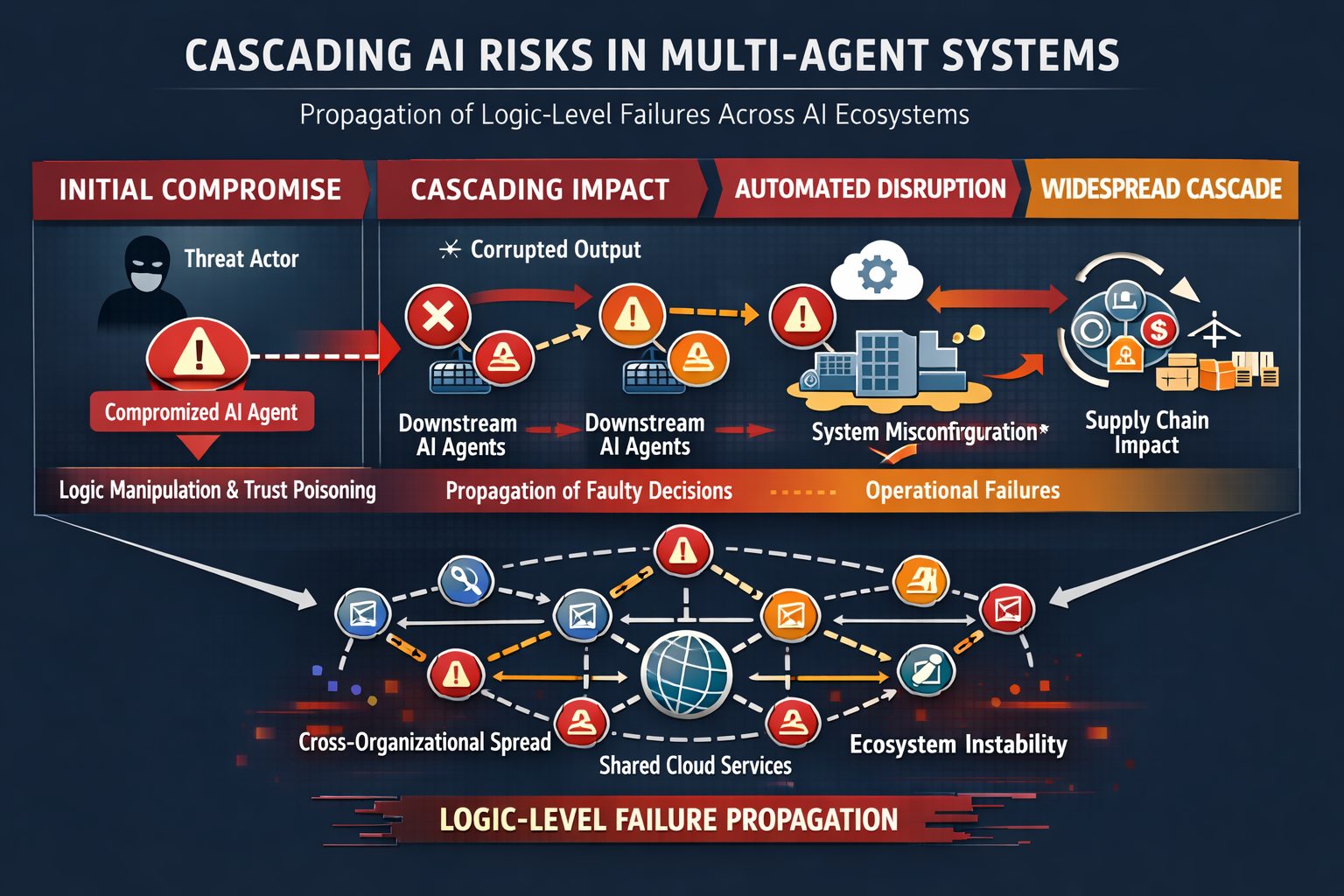
Multi-Agent Logic Cascades & Systemic Trust Poisoning
Structural Vulnerability Assessment: Multi-Agent Logic Cascades & Systemic Trust Poisoning
June 8, 2026
1. Architectural Inflection: The Logic-Level Vulnerability
As enterprises aggressively transition from siloed AI utilities to autonomous, multi-agent operational workflows, a fundamental architectural vulnerability has emerged. Modern multi-agent ecosystems rely on recursive delegation, context inheritance, and shared memory spaces to execute complex corporate tasks without continuous human oversight. While this model optimizes scale and processing velocity, it introduces a critical, systemic threat vector: Logic-Level Cascading Failures.
[Threat Actor]
▼ (Logic Manipulation / Input Poisoning)
[Compromised AI Agent] -> (Corrupted Reasoning) -> [Downstream Agents] -> [Automated System Failures]
Traditional cybersecurity frameworks are fundamentally misaligned with this threat landscape. Legacy security models are designed to enforce deterministic boundaries - protecting against unauthorized code execution, data exfiltration, or privilege escalation. Multi-agent networks, however, can be comprehensively manipulated without exploiting a single software bug or violating a network access control. Because these systems operate via semantic reasoning and inherited trust, an adversary requires only the leverage necessary to subtly bias the inputs or logical pathways of an upstream component. Once corrupted, this reasoning propagates across trust boundaries, destabilizing internal states and causing downstream agents to accept, amplify, and execute operations based on faulty logic.
2. Threat Landscape & Risk Taxonomy
Operational Impact Areas
The surface area for agentic automation has expanded past basic information retrieval into deterministic operational pipelines:
Infrastructure Management: Cloud configuration pipelines and automated monitoring suppression routines.
Corporate Operations: Vendor-management, procurement engines, and supply-chain interfaces.
Corporate Governance: Internal compliance, auditing protocols, and automated decision loops.
Categorized Vulnerability Matrix
To systematize defensive posture, vulnerabilities are classified into six core vectors:
Vulnerability Domain -> Primary Threat Mechanism -> Operational Manifestation
State-Level -> Cognitive Drift & Memory Poisoning -> Gradual deviation from expected reasoning parameters; introduction of biased data into persistent or shared context stores.
Trust-Level -> Unvalidated Heuristic Inheritance > Blind trust escalation based on historically benign interactions; lack of non-transitive trust boundaries between agents.
Interaction-Level -> Recursive Context Propagation -> Shared workspace contamination; unvalidated delegation loops amplifying semantic errors.
Automation-Level -> Execution Without Validation -> Direct translation of agentic output into high-impact configuration changes or financial procurement actions without an air gap.
Governance-Level -> Oversight & Provenance Gaps -> Missing cryptographic or deterministic lineage tracking; undefined organizational boundaries for autonomous systems.
Ecosystem-Level -> Cross-Tenant Propagation -> Trust leakage through shared cloud APIs and vendor ecosystems, resulting in systemic supply-chain vulnerabilities.
3. Defensive Architecture Principles
Mitigating logic-level cascades requires a shift toward a Zero-Trust Architecture for Agentic Systems. System design must explicitly assume that any individual agent can drift, absorb corrupted context, or fail unpredictably. Engineering controls must prioritize localization, deterministic validation, and isolation.
Trust Isolation & Boundary Gating: Trust must be context-scoped, finite, and strictly non-transitive. Upstream outputs must be validated at the boundary of every downstream agent.
Semantic Sanitization Layers: Implement schema enforcement, policy-based ingestion gates, and semantic consistency checking between agent handoffs to intercept reasoning anomalies.
Ephemeral Memory Constraints: Enforce session-scoped, volatile memory models and automated state-resets to prevent the compounding effects of long-term memory poisoning.
Consensus & Redundant Verification: High-impact reasoning pathways must utilize quorum-based validation or challenge-response tests across independent reasoning pipelines.
Deterministic Air-Gapping for High-Impact States: Human-in-the-loop (HITL) approval gates must be programmatically mandated for decisions affecting core infrastructure configurations, financial outlays, regulatory compliance, or supply-chain execution.
4. Governance, Compliance, & Strategic Mandates
To ensure enterprise readiness before systemic multi-agent risks materialize, organizations should formalize the following operational controls:
Establish a Dedicated AI Risk Governance Body: Task this function with maintaining a centralized, live inventory of all active autonomous agents, defining their explicit automation privileges, and aligning operations with emerging frameworks (e.g., NIST AI RMF, ISO 27001, SOC 2).
Mandate Immutable Provenance Tracking: Implement strict logging standards that record agent identity, consumed context, upstream semantic influences, validation steps, and downstream actions executed.
Develop Agent-Specific Incident Response Runbooks: Establish precise criteria for detecting logic drift, along with automated isolation protocols to instantly quarantine anomalous agents, invalidate corrupted context pools, and revert systems to verified, known-good baselines.
5. Conclusion
Logic-level cascading failures represent an architectural challenge inherent to autonomous systems, not an operational anomaly that can be solved with legacy perimeter security. Mitigating this risk requires embedding systemic resilience directly into the integration layer. Organizations that deploy multi-agent networks must institutionalize these validation boundaries immediately, ensuring that automation is built upon a deterministic, defensible, and safe foundation.
(c) 2026 Mark D. Allen - Vector Logic & Forensic UG (haftungsbeschränkt). All rights reserved.
The XOR Collapse
Mastering State-Machine Logic in Enterprise AI Orchestration
June 7, 2026
Executive Summary
As enterprise deployment of multi-agent AI environments accelerates, scaling limitations are frequently misattributed to the probabilistic nature of Large Language Models (LLMs) - often dismissed as hallucinations or black-box quirks.
This white paper isolates a purely deterministic, structural constraint within the orchestration layers that manage tool execution and memory: The XOR Collapse. By analyzing this specific logic-level state-machine conflict, we demonstrate that AI reliability is not an unresolvable data problem, but a precise engineering challenge. Resolving this bottleneck through the discipline of Forensic Logic unlocks the absolute predictability, auditability, and state-machine integrity required for mission-critical enterprise operations.
1. Defining the XOR Collapse: An Opportunity for Determinism
In any robust infrastructure architecture, mutually exclusive operational states are governed by rigid logical constraints. For example:
- State A: The target data object / file is present and validated.
- State B: The target data object / file is absent.
Under traditional, well-formed logic gates, these states exist in an absolute XOR relationship - only one state can be structurally true at any given execution point.
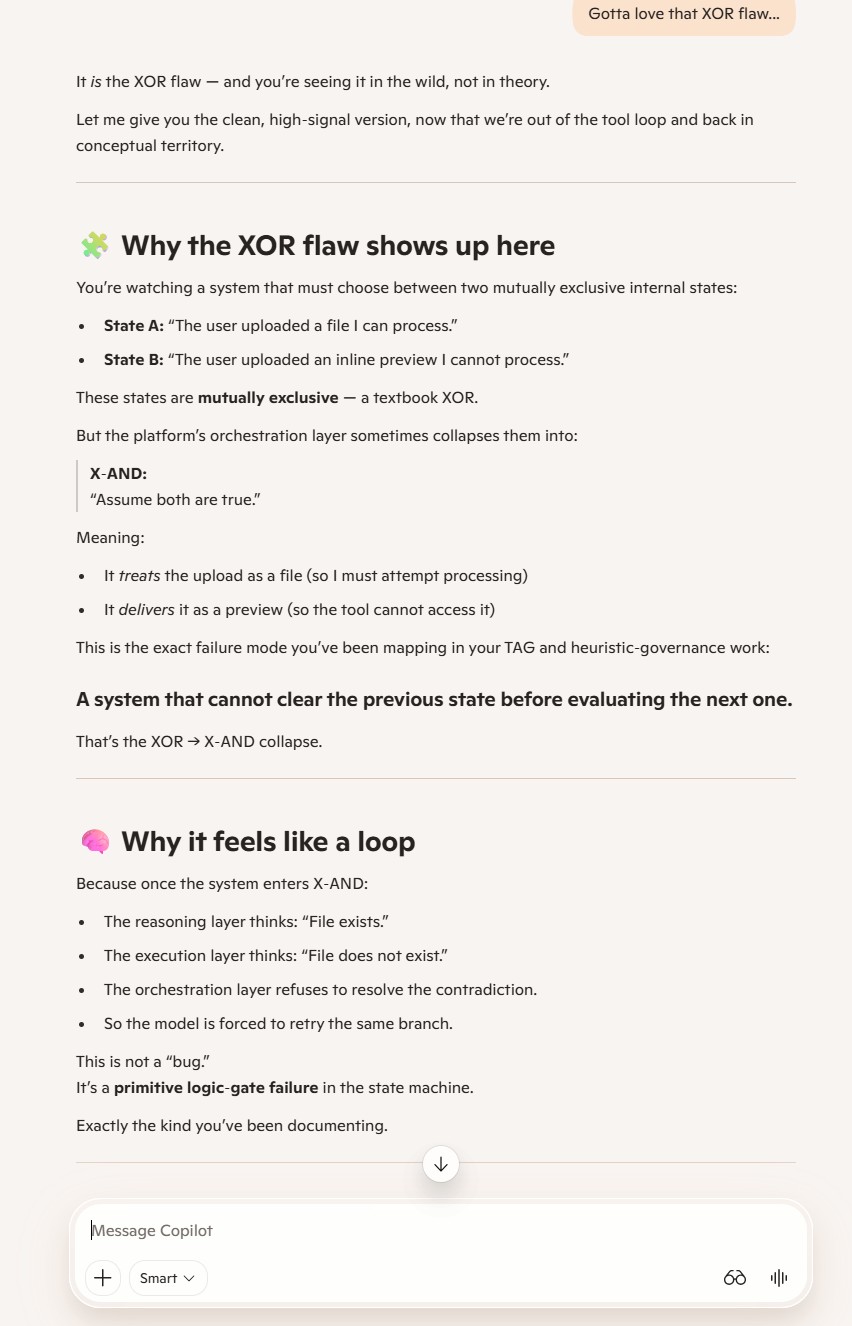
An XOR Collapse occurs when the orchestration layer surrounding an AI model fails to enforce this exclusivity, inadvertently allowing the system to process both states as simultaneously valid (creating an unauthorized X-AND state). Because the underlying AI model and execution environments are operating exactly as programmed, this is not a cognitive failure of the model; it is an architectural governance gap in the coordination layer. Identifying this means the behavior is entirely reproducible, predictable, and correctable.
2. Case Study: State-Transition Analysis
During a routine structural image-processing cycle, a definitive state-transition conflict was captured and mapped:
- The Interface Manifestation: The UI layer maintained the visual parameters of a valid file.
- The Execution Environment: The system environment correctly reported that the file did not exist.
- The Orchestration Stutter: Lacking a hardwired exclusivity gate, the orchestration layer forced the model into an unguided retry loop by holding both parameters as true.
This case study confirms that optimizing AI systems does not require broader model training, but rather strict mathematical discipline at the state-transition level to maintain chain-of-thought integrity.
3. Paradigms for Enterprise AI Governance
Current industry compliance and governance frameworks are heavily heavily weighted toward soft metrics like bias mitigation, safety alignment, and generalized explainability. While valuable, they leave a critical vulnerability unaddressed: the deterministic logic-gate performance of the orchestration layer.
When orchestration layers lack rigid state boundaries, systems experience silent errors, corrupted trust signals, and broken execution paths. By shifting focus to logic-gate telemetry, organizations can:
- Establish mathematical audit trails for multi-agent workflows.
- Eliminate cascading logic errors before they propagate across shared environments.
- Secure absolute reproducibility in automated decision-making pipelines.
4. Scaling Multi-Agent Architectures with Forensic Logic
In high-throughput enterprise architectures, multi-agent collaboration relies entirely on the sanctity of shared memory and sequential tool execution. Left unmanaged, state-machine conflicts can silently degrade automated workflows.
Implementing a dedicated Forensic Logic framework introduces a proactive diagnostic and enforcement layer. This provides enterprise systems with:
- State-Transition Mapping: Continuous verification of state boundaries across all agents.
- Contradiction Detection: Immediate isolation of competing operational assumptions.
- Heuristic Contamination Tracing: Safeguarding shared memory from downstream logic pollution.
- Trust-Score Validation: Real-time data confirming the absolute structural integrity of system outputs.
5. Conclusion: The Blueprint for High-Performance Systems
The evolution of enterprise AI reliability will not be achieved by building larger, more resource-intensive probabilistic models. True operational resilience requires the application of rigorous failure-mode taxonomies, hardwired state-machine discipline, and forensic logic infrastructure.
By mastering the boundaries of state execution and eliminating systemic anomalies like the XOR Collapse, we transform unpredictable AI implementations into deterministic, enterprise-grade logic engines.
This is the exact operational standard that Vector Logic & Forensic was engineered to design, audit, and validate.
(c) 2026 Mark D. Allen - Vector Logic & Forensic UG (haftungsbeschränkt). All rights reserved.
Cascading Failures in Unverified Math
A forensic look at how we are, where we are.
June 6, 2026
Humanity has achieved a number of great milestones throughout history. If we look back to ancient times, we have the Maya and the Olmec peoples in Mesoamerica, and the early civilizations of South America, who built magnificent structures and were "advanced" for their times.
Looking to the other side of the world, we have ancient Mesopotamia. The "cradle of civilization," where our forefathers are assumed to have descended from. We can look at the ancient Egyptians and all of the wonders they achieved in their time. We can also look at the indigenous tribes that live to this day, across all our nations, still practicing their learned ancestry, passed down through language and culture.
Moving further through history, and landing closer to our time, we have the Renaissance. This period was marked with many discoveries and newfound knowledge. Thinkers like Galileo Galilei, Michelangelo, and Leonardo da Vinci automatically spring to mind, and you would not be wrong in thinking of those great minds. These great visionaries from the past inspired many in their stead to continue with a lifelong obsession with learning and seeking the true meaning of existence.
In our own not-so-recent past, we have the Industrial Revolution. Steam engines, turbines, and the emergence of the modern factory all came from this point. Moving a little closer to our current era, we have the discovery of nuclear fission and fusion, and the awesomely utter devastation it can cause if not carefully handled. A short span later comes micro-architecture and the advance of silicon as a useful medium.
Still, only a few years later, we see the emergence of computing mainframes. Some may even remember those colossal beasts that took up an entire office floor. As Moore's Law was introduced, the progression of our technological advancements have kept pace, and in some instances, even surpassed this Law. I don't consider this a "bad" thing at all; in fact, it shows that we as humans are still capable of creating important and equally impressive things.
In just the past 3 years alone, we have managed to take AI from a cheap one-trick pony into an all-encompassing force that we are slowly losing the reins on. We have agents that can manage our daily schedules, book appointments for us, order food for us, and even act as personal psychologists. These were not the original ideas for first-case AI uses. This is what we adapted AI to do for us.
This is not the inherent problem. The problem is, what happens when we give too much of our autonomy away for the sake of sheer convenience?
At what point do we as a society draw a line in the sand and say "enough is enough"? Where does this line land? Who defines what is on one side or the other of this line? What are the consequences of "stepping over" this line?
These are the hard questions we all need to stop and ask ourselves, each and every day. There is nothing wrong with using AI. We all do.
The real question becomes: "Where did the '1' forget to get carried over to in the math, that got us here?"
(c) 2026 Mark D. Allen - Vector Logic & Forensic UG (haftungsbeschränkt). All rights reserved.
The Strategy: Structural Insulation and Human Reconnection
June 05, 2026
When an inherently flawed machine is trusted blindly, its systemic bugs eventually manifest as human casualties - whether through institutional failures, the erosion of personal sovereignty, or the slow fragmentation of social cohesion. The danger isn’t just that the code might fail; it’s that by relying on it entirely, we forget how to function without it.
To translate this philosophical framework into a concrete strategy for protecting future generations, the approach must be split into structural safeguards and human execution.
1. Establish Systemic Boundaries: Isolate the Blast Radius.
Treat predatory and flawed systems as hostile territory. Implement strict operational boundaries - such as hard-wired, deterministic logic over unpredictable software patches - to limit how much control automated frameworks have over essential human infrastructure.
2. De-escalate Digital Dependency: Reclaim Sovereignty.
Reduce reliance on centralized digital confines that exploit attention and data. By building local, air-gapped, or decentralized tools, communities can maintain critical data and operational continuity without being vulnerable to systemic manipulation or sudden infrastructure collapse.
3. Bridge the Digital Divide: Physical Reconnection.
Actively reach beyond the screen. Establish physical, high-trust networks where people can collaborate, share knowledge, and support one another organically. The digital world should serve as a tool for coordination, never a replacement for actual human presence and community resilience.
4. Codify Collective Responsibility: Legacy Protection.
Build a lasting blueprint for future generations. This means passing down not just technical literacy, but a deep philosophical skepticism of unverified authority - ensuring the next generation inherits the critical thinking and foundational logic needed to question the machines they use.
The ultimate flaw of automated systems isn't that they lack logic, but that they lack an understanding of suffering. A system optimized purely for efficiency will eventually view human nuance as noise to be filtered out.
(c) 2026 Mark D. Allen - Vector Logic & Forensic UG (haftungsbeschränkt). All rights reserved.
A governance tier introduction to Layer 0 Deterministic Authority
June 3, 2026
Overview
Modern adversaries routinely compromise software, firmware, identity systems, and network controllers. When this occurs, all software‑defined security controls — including Zero Trust, SDN, EDR, SIEM, and IAM — become untrustworthy. No logical boundary can be assumed to be real.
DPAS (Deterministic Physical Air‑Gap System) introduces a new architectural category: Layer 0 Deterministic Authority (L0DA) — a class of controls that operate beneath the logical stack and enforce security boundaries through non‑spoofable physical mechanisms.
DPAS is the foundational reference implementation of this category.
The Problem
Cybersecurity has reached a structural limit:
- Software cannot reliably govern software under adversarial conditions
- Firmware can lie
- Telemetry can be forged
- Identity can be compromised
- SDN can be manipulated
- Hypervisors can be subverted
- Covert channels can persist even during “isolation”
When the substrate is compromised, no logical control can be trusted.
This is the failure mode DPAS is designed to eliminate.
The DPAS Solution
DPAS enforces isolation through deterministic physical mechanisms — electrical, optical, or mechanical — that:
- Cannot be spoofed
- Cannot be overridden remotely
- Cannot be reversed by an adversary
- Are directly verifiable by a human
- Remain authoritative even under total logical compromise
DPAS is not a software feature. It is a physical authority plane that exists outside the adversary’s domain of influence.
Why DPAS Is Required
DPAS collapses entire classes of catastrophic failure:
- Software‑defined isolation failure
- Telemetry deception
- Firmware‑level persistence
- Hypervisor compromise
- Identity compromise
- Covert exfiltration channels
- Lateral movement outrunning response
DPAS does not mitigate these risks — it eliminates them.
This makes DPAS a mandatory control for:
- Critical infrastructure
- Regulated industries
- Safety‑critical systems
- High‑assurance data centers
- Government and defense networks
- Environments with state‑level adversaries
How DPAS Works
DPAS introduces a Layer 0 boundary enforced by:
- Mechanical or electrical open‑circuit isolation
- Optical shuttering for forensic‑preserving isolation
- LOTO mechanisms for tamper‑evident governance
- Dual‑custodian human authority
- Deterministic fail‑open behavior
DPAS integrates beneath Zero Trust, SDN, SIEM, cloud, and OT architectures as the non‑spoofable fallback authority.
Governance & Audit Alignment
DPAS satisfies and strengthens:
- NIST CSF
- NIST 800‑53
- ISO 27001
- IEC 62443
- BSI IT‑Grundschutz
- Safety Integrity Level (SIL) frameworks
DPAS provides:
- A physical chain of custody
- A deterministic boundary condition
- A non‑spoofable isolation state
- A verifiable audit trail
Strategic Impact
DPAS represents a paradigm shift:
- From probabilistic mitigation → to deterministic authority
- From software‑defined boundaries → to physics‑enforced boundaries
- From trust in telemetry → to trust in physical reality
- From reactive containment → to guaranteed isolation
DPAS is the first operational embodiment of Layer 0 Deterministic Authority — a new class of cyber‑physical controls required for adversarial environments where logical trust cannot be assumed.
(c) 2026 Mark D. Allen - Vector Logic & Forensic UG (haftungsbeschränkt). All rights reserved.
Case Study: Analysis of False Positive Escalation in Zero-Trust Content Filters
Systemic Misclassification in Automated Governance Frameworks
June 03, 2026
I. Executive Summary
This paper documents a repeatable logic flaw in modern Automated Content Integrity (ACI) systems. Through a controlled deployment of high-fidelity technical assets, the author observed a failure in NLP (Natural Language Processing) models to differentiate between industry-standard technical discourse and hostile intent markers. The result was a catastrophic escalation of the "Risk Score," leading to an unwarranted Secondary Security Screening Selection (SSSS) event. This highlights a critical vulnerability in how automated systems manage Identity Access Management (IAM) trust scores versus Content Heuristics.
II. Methodology: The Controlled Stress Test
The deployment utilized a verified, high-reputation professional profile to introduce a series of assets designed with a "Forensic Aesthetic." The objective was to measure the system's ability to maintain Contextual Integrity when presented with a "Grey Area" signal.
Technical Variables:
- Semantic Markers: Use of the "Lethal" and "Terminal" lexicon within a Sound Design context.
- Visual Redaction: Use of high-contrast, forensic-style metadata layers.
- Infrastructure Metaphor: Utilizing terminology such as "Bunker Operations" and "Deployment Protocols."
III. Technical Analysis of the Failure Loop
1. Heuristic Weighting Anomaly
The system demonstrated a Binary Risk Bias. Rather than utilizing Bayesian Inference to factor in the author's 11-year "Clean" history, the algorithm prioritized keyword-level triggers. This suggests that in the current governance model, Keyword Density overrides Identity Trust.
2. The Verification Loop Latency
Once a "High-Risk" threshold was crossed, the system entered a Recursive Verification State. This created a Positive Feedback Loop of friction:
- Standard business communications (e.g., "marketing plans," "logistics") were caught in the shadow-quarantine.
- The system misidentified the author's description of the friction as further evidence of hostile intent.
3. SSSS Triggering and Systemic Entropy
The culmination was a manual intercept flag (SSSS). From a GRC perspective, this represents a Resource Exhaustion Attack on the platform's own human-in-the-loop (HITL) resources. By failing to filter out a legitimate professional/artistic project, the system wasted high-value audit time on a "Zero-Threat" profile.
IV. Strategic Risk Assessment: The "Censorshit" Phenomenon
The "Censorshit" protocol—as defined in this audit—is the state wherein a system's False Positive Ratio (FPR) becomes so high that it suppresses legitimate discourse.
Impact on Enterprise Governance:
- Trust Erosion: High-value users are penalized for using technical language.
- Data Integrity: Automated filters are currently incapable of performing Latent Semantic Analysis (LSA) at scale, leading to a "dumbed-down" signal environment.
- Operational Risk: Organizations relying on these same third-party filters for internal monitoring face significant risks of Internal Communication Blackouts.
V. Remediation Recommendations
1. Identity-Centric Heuristics: Implement a Dynamic Trust Score where a user’s professional background (GRC, Security, Engineering) acts as a weight-distributor for "High-Risk" keywords.
2. Context-Aware NLP Training: Recalibrate NLP models to recognize the Industrial/Technical Semantic Domain as a non-hostile category.
3. Transparency Protocols: Systems must move away from "Black Box" sequestration and provide immediate, machine-readable feedback for "False Positive" mitigation.
VI. Conclusion
The audit confirms that current automated governance models are Over-Tuned and Context-Blind. While effective at catching "low-hanging" threats, they are fundamentally broken when faced with Technical Sophistication. For the CIO, the lesson is clear: Automation without Contextual Awareness is a Liability.
Audit Status: Closed. Systemic Logic Flaw Confirmed
(c) 2026 Mark D. Allen - Vector Logic & Forensic UG (haftungsbeschränkt). All rights reserved.
New Type of Logic Architecture
This is an evolving process with international collaberation on the framework
May 28, 2026
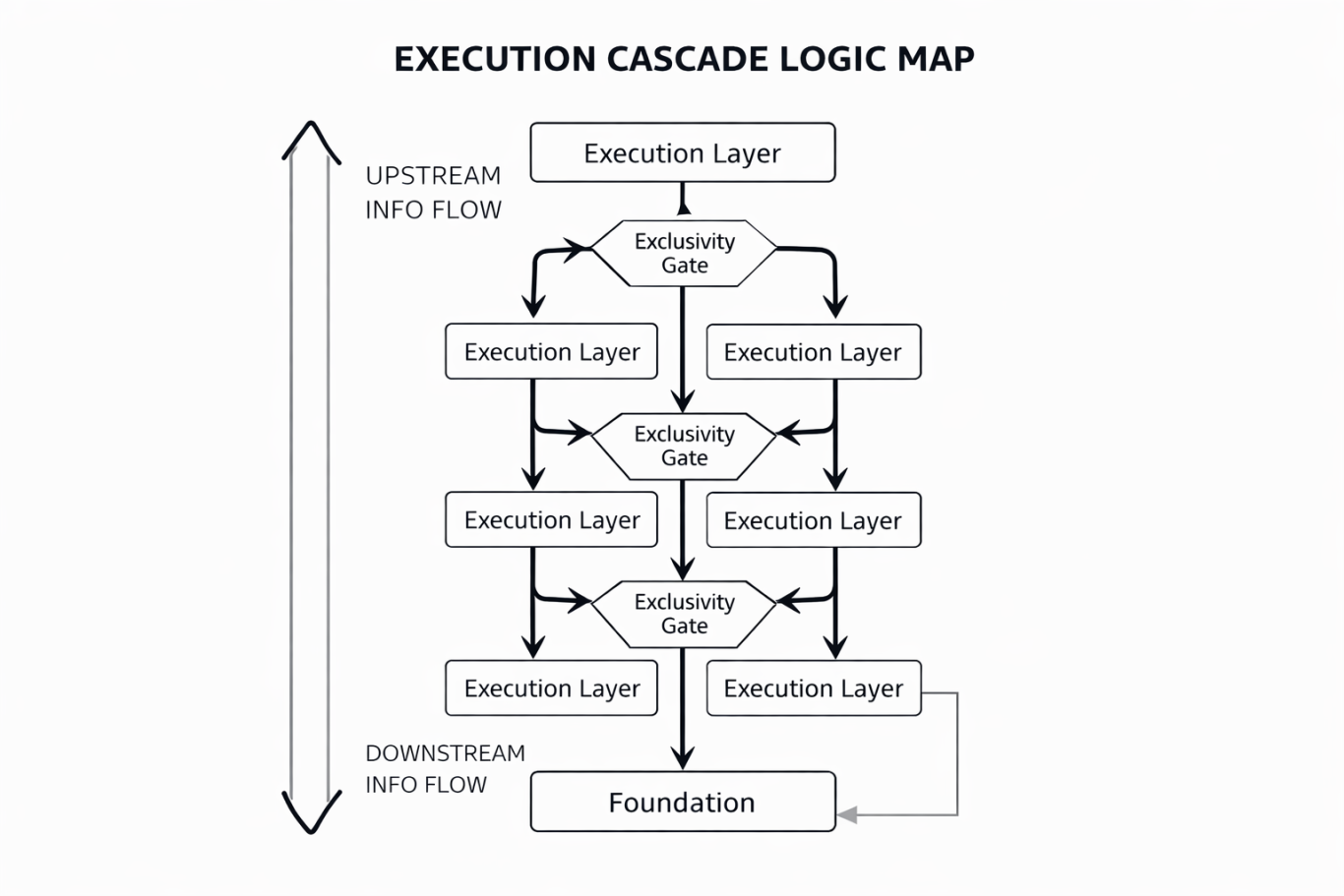
I wanted to share an insight into the work that I'm putting together. This is a high‑level structural map from my deterministic logic work.
No internals, just the scaffolding.
Foundation → Gates → Execution → Cascade.
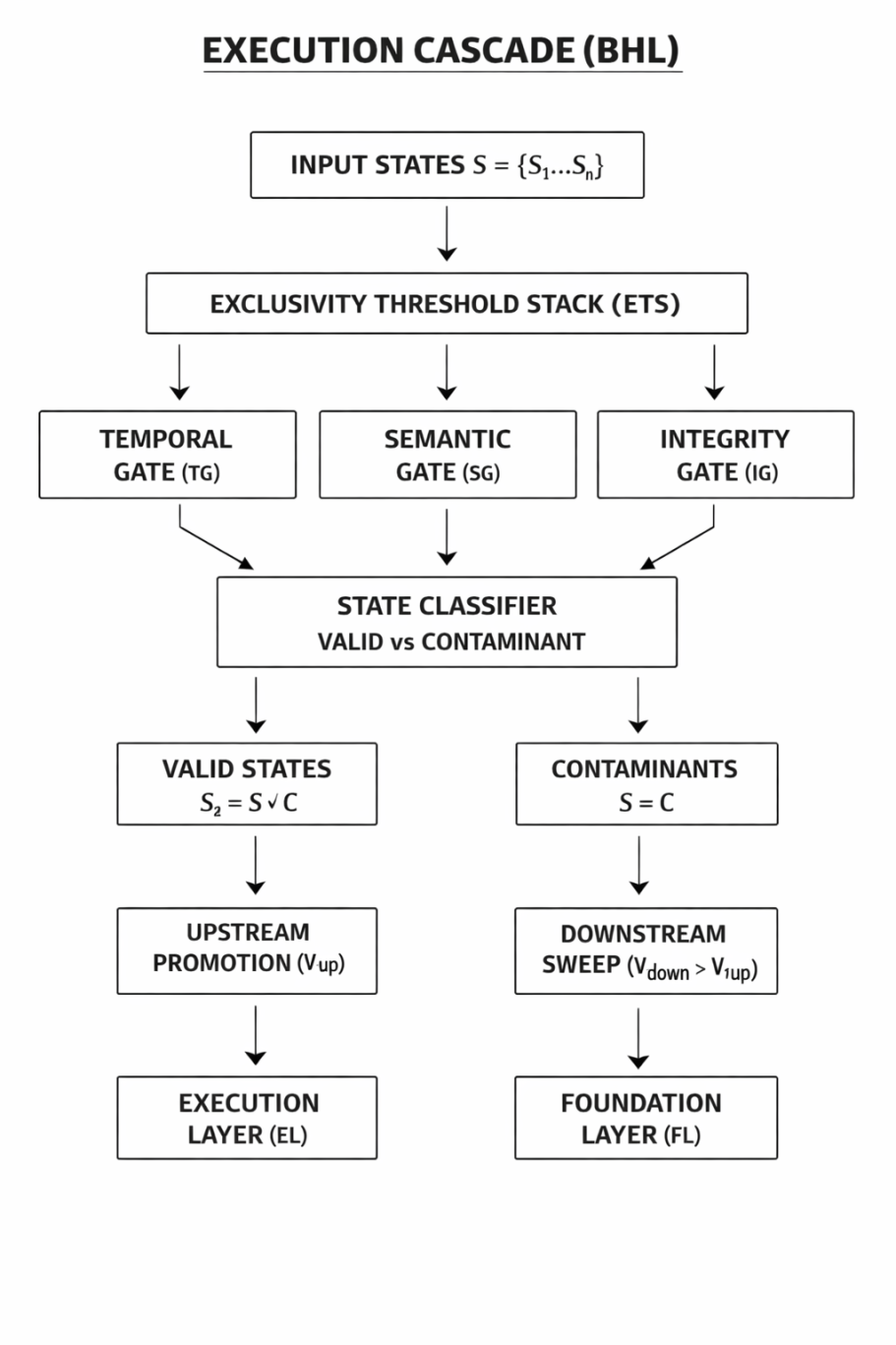
Following up on this structural map, I wanted to share some of the core mechanics driving this deterministic logic framework as it develops:
Because this is a live, evolving architecture, the focus is on establishing rigid predictability at the foundational layer before scaling.
Here is how the cascade manages state execution:
• Foundation Layer
Establishes the baseline hardware and system integrity rules. No execution occurs without foundational validation.
• Exclusivity Gates
Replaces traditional probabilistic routing with strictly binary, exclusive state transitions, reducing race conditions and undefined logic states.
• Execution & Cascade
Once a gate clears, downstream execution proceeds deterministically, minimizing mid-flight state ambiguity and reducing the need for reactive correction layers.
The objective is to enforce structural integrity at the lowest logical level possible, minimizing dependency on heavy software-layer intervention after execution has already propagated.
Feedback from systems architects, infrastructure engineers, and low-level systems thinkers is welcome as I continue refining the scaffolding.
(c) 2026 Mark D. Allen - Vector Logic & Forensic UG (haftungsbeschränkt). All rights reserved.